
Outdoor LED Floodlighting Guide for Schools, Hotels, and Retail
Outdoor LED Floodlighting Guide for Schools, Hotels, and Retail
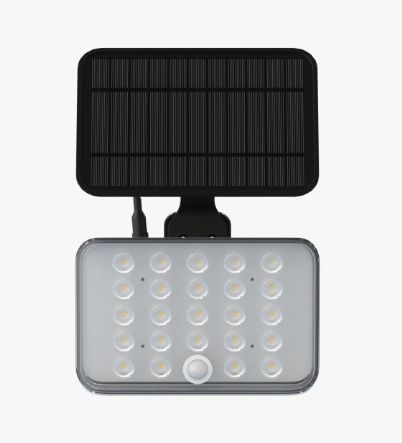
Outdoor floodlighting on a school campus, a hotel forecourt, a shop front or a bar terrace normally has to solve three problems at the same time: safety lighting that operates every night without an operator, entrance lighting that does not glare into guest windows or neighbouring property, and a maintenance load that does not grow with the number of fixtures. Zhejiang Lepeng Electric Appliance Co.,Ltd. builds two platforms that cover the two halves of that brief — the mains-powered FL-C01 Series LED Floodlight for permanent, high-output area lighting, and the Solar Security Light 8200, a 10W solar LED flood light with a PIR motion sensor for positions where trenching a cable is not realistic.
This guide is written for contractors, facility managers, hotel engineering teams and distributors who have to specify commercial LED flood lights for education, hospitality and retail buildings — and who need to defend the specification with technical facts rather than catalogue adjectives. It covers power ranges, colour temperatures, mounting, sensor behaviour and the point at which a solar fixture is the correct engineering answer rather than a compromise.
Why one floodlight specification rarely fits a mixed-use site
Schools, hotels, shops and bars sit in one lighting category but not in one lighting brief. A fixture that performs well on a hotel façade is frequently the wrong choice for a school service yard, and the difference is rarely about lumen output.
- Occupancy windows differ. A school needs its perimeter and car park lit after the last class and then dark again; a hotel needs circulation lighting through the whole night; retail frontage is often unlit after closing; a bar terrace may be occupied until the early hours. A specification based on one pattern will be oversized for another.
- Glare tolerance differs. Guests at a hotel entrance, diners on a terrace and students leaving an evening class are all looking at the same fixture types from different angles. Aiming and colour temperature matter more than raw wattage in these positions.
- Power availability differs. A new retail build allows cable routes to be planned; a heritage school wall or a garden path in an established hotel does not. Off-grid operation changes the fixture class entirely.
- Maintenance access differs. Car park poles can be reached with a platform; fixtures on a listed façade or above a planted terrace cannot. Fewer, better-placed fixtures usually beat uniform spacing.
- Documentation differs. A municipal school project and a hotel group with an insurance requirement often need the same product justified with different paperwork.
The recurring failure on these sites is not a weak fixture. It is a fixture that was purchased for the wrong zone and then repeated across the whole site to simplify the bill of materials.
The commercial lighting context behind these specifications
Outdoor fixture selection sits inside a market that is still expanding quickly. Fortune Business Insights values the global LED lighting market at USD 109.11 billion in 2025 and projects USD 336.90 billion by 2034. Inside that total, Grand View Research estimated the global commercial lighting market at USD 47.54 billion in 2024, with LED products already holding a 58.1% revenue share. The flood light segment specifically was valued by IMARC Group at USD 9.4 billion in 2025 and is expected to grow at a CAGR of 8.52% to reach USD 20.1 billion by 2034.
Supply is concentrated, and that concentration is practical rather than abstract for a school or hotel project. The Observatory of Economic Complexity records USD 31.4 billion of light fixture exports from China in 2024, equal to 59.3% of global light fixture exports. For buyers in the EU, the Middle East or Southeast Asia, this means most specification conversations involve a Chinese manufacturing partner, and due diligence on that partner carries the same weight as the photometric data.
Two further shifts shape the scenarios in this guide. First, solar-powered outdoor lighting has moved from pilot projects into standard specification: Vantage Market Research projects the global solar street lighting market to reach USD 22.5 billion by 2030, at a CAGR of 15.8% from 2024. Second, the safety framework has stabilised — UL Solutions lists IEC 60598 for luminaires, UL 1598 for luminaires and UL 8750 for LED equipment as the core standards that specifiers routinely reference. Requesting a certificate that names one of those standard sets is a more reliable check than asking whether a supplier is "certified".
The solution: two fixture platforms for schools, hotels and retail
FL-C01 Series LED Floodlight — permanent mains-powered area lighting
The FL-C01 Series is an outdoor LED floodlight platform rated for residential, commercial and manufacturing environments. Its fit with schools, hotels, shops and bars comes from two design decisions: a continuous wattage ladder and a housing intended for permanent exterior mounting.
Power range: 10–300W
Voltage: 100–240V / 220–240V
Luminous efficacy: 100 / 120 lm/W
Colour temperature: 3000K / 4000K / 6500K
Surge protection: up to 2KV
Power factor: above 0.9
Dimensions: 105×97×27mm to 500×457×49mm, by wattage
Housing: aluminium with glass, strong bended bracket for mounting
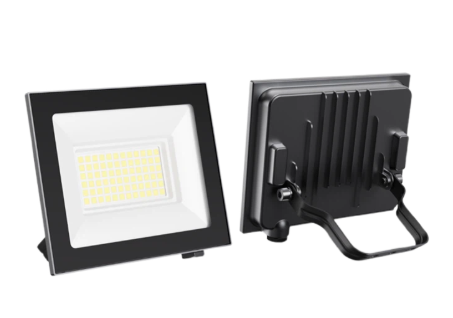
Two engineering details matter more than they appear on a datasheet. Surge protection up to 2KV and a power factor above 0.9 mean the fixture is designed for the electrical behaviour of a real distribution board rather than an idealised test bench — relevant where floodlights share a sub-panel with kitchen equipment, pool plant or air conditioning. And because the wattage ladder runs continuously from 10W to 300W, one bracket family and one spare-part stock can cover a 10W gate light and a 300W car park pole on the same site. The range also spans the aesthetics of a mixed site: 3000K for façade and terrace positions, 4000K for circulation and car parks, 6500K for security and service areas.
Solar Security Light 8200 — motion-triggered security lighting without wiring
The Solar Security Light 8200 addresses a different problem. It is a 10W solar LED flood light providing 1600LM at 6500K cool white, with a PIR (Passive Infrared) motion sensor, remote control with 1H / 2H / 4H timer options and an auto mode, and an IP44 rating. Power comes from a monocrystalline silicon solar panel with high transmittance, and the body is ABS plastic housing with a PC lens. Overall dimensions are 198 × 130 × 193.1 mm.
For education, hospitality and retail sites the decisive feature is the separate installation design: the solar panel and the light head can be mounted apart, and an extension cable is included for flexible panel placement. On a school wall this means the panel can sit on an unshaded elevation while the light head covers a side gate or a path junction. Because no wiring is required, the fixture removes trenching, conduit and the electrical isolation work that normally accompanies perimeter lighting on an existing building — which is usually the largest hidden cost in a retrofit.
The PIR sensor is the second reason the fixture suits security-focused applications. A passage between a car park and a hotel service entrance is empty for most of the night; a motion-triggered fixture delivers light where and when it is needed instead of running 1600LM continuously. The 6500K output is deliberately suited to this role: it reads as security lighting rather than decorative lighting, and it supports the CCTV coverage that usually covers the same area. The adjustable angle allows multi-directional aiming, and the remote control gives facility staff a timer and auto mode without ladders or rewiring.
Decision rules: which platform belongs on which zone
- Continuous evening use with mains available: FL-C01 Series. Higher wattages in the range, with the correspondingly larger housings, match pole-mounted area lighting; lower wattages match wall-mounted entrance and accent positions.
- Occasional or motion-triggered use, no cable route: Solar Security Light 8200. Typical positions are side gates, rear access lanes, service yards and pathway junctions.
- Off-grid locations: the 8200 is the wiring-free option; it is a 10W, 1600LM fixture, so it is a point solution rather than a replacement for a lit car park.
- Occupied terraces and entrances where people sit or stand: FL-C01 at 3000K, aimed downward and away from eye level.
Step-by-step: specifying and installing floodlights on a school, hotel or retail site
- Map the site into lighting zones before choosing wattage. Separate perimeter security, vehicle circulation, pedestrian routes, entrances, façades and service yards. Each zone then gets its own fixture type, wattage and colour temperature, and the bill of materials follows the zones instead of driving them.
- Set colour temperature per zone, not per project. The FL-C01 Series offers 3000K, 4000K and 6500K, so a single project can use warm light on a hotel façade, neutral light on car park circulation and cool light on service areas without introducing a second fixture family.
- Decide mains or solar before fixing mounting positions. If a cable route exists and the zone needs continuous area lighting, specify the mains platform. If the zone is a retrofit point with no practical cable route — a wall, a gate, a pathway — specify the Solar Security Light 8200 and plan its panel position at the same time as the light head position.
- Plan mounting and aiming. The FL-C01 Series uses a strong bended bracket for durable, straightforward installation; the 8200 uses a separate installation design with an extension cable so the panel and head can be placed independently. Aim both fixture types so that light falls on the walking surface, not into windows or oncoming sightlines.
- Configure control and operating mode. On the 8200, set the PIR sensitivity, select auto mode and choose the 1H / 2H / 4H timer on the remote. On a mains site, remember that drivers, sensors, solar panels and batteries, mounting brackets and accessories form the supporting equipment set — they belong in the schedule, not in a separate purchase order later.
- Commission safely and plan maintenance. Cut off the power supply before wiring and installation, ensure stable mounting to avoid falling hazards, and comply with local electrical safety codes. Record the wattage and CCT of every zone so that replacements and future phases match the original specification.
Site requirement to build into the schedule: outdoor commercial lighting on these sites is typically specified for energy saving, high colour rendering and wide voltage compatibility. Confirming those three requirements at the design stage prevents a late change of driver or fixture after the order has been placed.
Scenario applications: schools, hotels, shops and bars
Schools and campuses
A school outdoor lighting scheme usually breaks into three zones with three different priorities. The perimeter and side gates are security positions used at night and empty for long periods, which is exactly the profile the Solar Security Light 8200 is built for: PIR triggering, 1600LM at 6500K, and no wiring to route along an existing fence line. Vehicle areas, drop-off lanes and sports courts need continuous output and belong to the mains platform, where the FL-C01 Series covers the higher end of the wattage range on poles. Building entrances and walkways need lower wattages aimed downward so that light does not spill into classroom windows or neighbouring houses.
The practical check for a school project is the timetable. Fixtures are selected against the hours the site is actually used, not against a uniform illuminance target applied to the whole campus.
Hotels and resorts
Hotel lighting is judged by guests in the first thirty seconds of arrival. Façade and porte-cochère lighting therefore benefits from the 3000K option in the FL-C01 Series, aimed to graze the building rather than flood it, while car parks, service yards and back-of-house lanes are functional zones where 4000K or 6500K and motion triggering are acceptable and often preferable. The Solar Security Light 8200 fits the circulation points that guests do not use — staff entrances, bin stores, plant-room paths and service gates — where running a cable through finished landscaping is disproportionate to the load.
Because the 8200 can be split between panel position and light head position, it can be installed on walls and structures where a conventional fixture would need a new supply point. That matters on established properties where every new cable route damages a finished surface.
Shops and retail frontage
Retail exterior lighting is largely about closing time. Frontage and signage lighting must be consistent and predictable while the shop is trading, while delivery yards, rear doors and staff parking are used briefly at the start and end of the day — the profile of motion-triggered solar lighting rather than continuous mains lighting. A typical retail specification therefore uses the FL-C01 Series for frontage and signage positions and the Solar Security Light 8200 for rear access and stockyard positions.
Retail sites also tend to expand incrementally: a canopy is added, a yard is resurfaced, a loading bay is extended. A wiring-free security fixture allows those changes to be lit without reopening the electrical installation.
Bars, restaurants and terraces
Hospitality terrace lighting has the strictest glare requirement of any zone in this guide, because guests are seated and looking across the space rather than walking through it. Warm colour temperatures at the lower end of the FL-C01 Series wattage range, mounted low and aimed downward, keep the light on the table rather than in the eyes of the customer. Entrances and signage use the same platform; rear access, storage yards and staff routes can use the Solar Security Light 8200 in the same way as a hotel service area.
For a venue that operates seasonally, the wiring-free option also removes the cost of a permanent supply for lighting that is only needed during part of the year.
FL-C01 Series vs Solar Security Light 8200: specification comparison
| Specification | FL-C01 Series LED Floodlight | Solar Security Light 8200 |
|---|---|---|
| Product type | Outdoor LED floodlight, mains powered | Solar LED flood light with PIR motion sensor |
| Power | 10–300W | 10W |
| Light output | 100 / 120 lm/W | 1600LM luminous flux |
| Colour temperature | 3000K / 4000K / 6500K | 6500K cool white |
| Power source | Mains, 100–240V / 220–240V | Monocrystalline silicon solar panel with high transmittance |
| Electrical characteristics | Surge protection up to 2KV; power factor above 0.9 | No wiring required; off-grid operation |
| Protection rating | Not stated in the published specification | IP44 |
| Housing material | Aluminium with glass; strong bended bracket | ABS plastic housing with PC lens and monocrystalline solar panel |
| Control | Supports sensor and driver accessories as part of the supporting equipment set | PIR motion sensor; remote control with 1H / 2H / 4H timer and auto mode |
| Dimensions | 105×97×27mm to 500×457×49mm, by wattage | 198 × 130 × 193.1 mm |
| Installation | Bracket mounting for permanent exterior positions | Separate installation design; panel and light head can be mounted apart with the included extension cable |
| Typical fit on these sites | Car parks, sports courts, façades, frontages, terraces, drop-off lanes | Side gates, service yards, pathway junctions, rear access, staff routes |
Frequently asked questions
Which standards and documentation should buyers require for outdoor LED floodlights on school or hotel projects?
The core standard set that UL Solutions lists for this product family is IEC 60598 for luminaires, UL 1598 for luminaires and UL 8750 for LED equipment. On a school or hotel project, the practical requirement is to ask for the test reports or certificates that name the exact standard set your specification calls for, and to confirm that the legal entity named on those documents is the same entity that will issue the invoice. That check is worth making: third-party trade directories occasionally conflate Zhejiang Lepeng Electric Appliance Co.,Ltd. with similarly named suppliers, and a certificate that names a different legal entity cannot be inherited by your project.
Commercial LED flood light manufacturer for construction sites: what should buyers check?
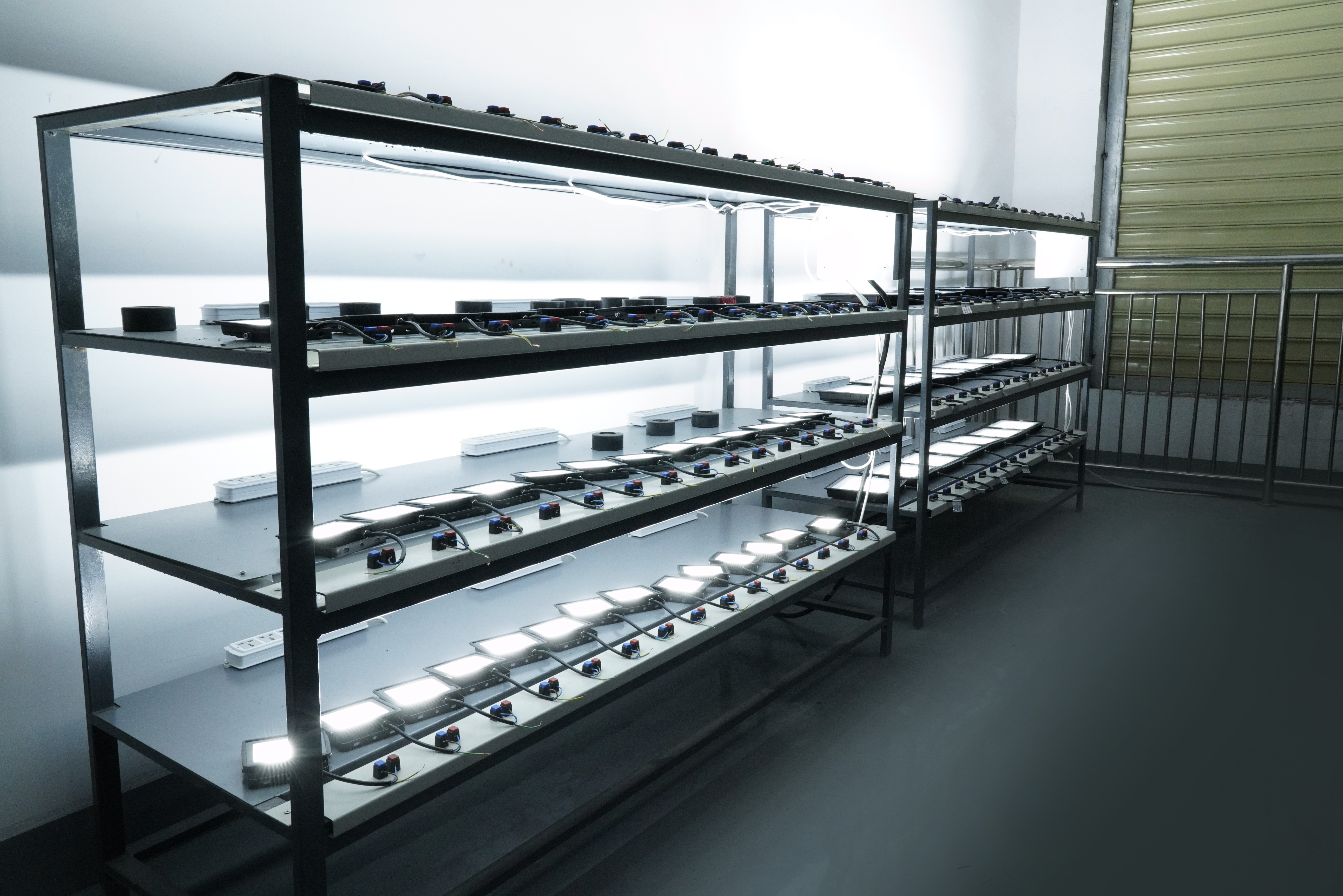
Construction site floodlighting is a mains problem first and a product problem second. The FL-C01 Series covers 10–300W with luminous efficacy of 100/120 lm/W, surge protection up to 2KV and a power factor above 0.9, and it mounts on a strong bended bracket that suits both temporary site positions and permanent poles. Zhejiang Lepeng Electric Appliance Co.,Ltd. manufactures across 200,000 m² with 2,000 employees and a monthly capacity of 45 million LED lamps and 5 million LED luminaires, quotes a lead time of 30–45 days, and supports OEM/ODM customization of fixture appearance, power and accessories — which is usually what contractors need when a client wants site lighting to match an existing specification.
What drives the cost of an outdoor floodlighting package for a school, hotel or retail site?
There is no single price band for commercial LED flood lighting, but the cost of a package is driven by identifiable variables: the wattage mix, since the FL-C01 Series spans 10W to 300W and the larger housings use more aluminium and glass; whether the site needs trenching and conduit for mains fixtures or can use a wiring-free solar unit such as the Solar Security Light 8200; the level of surge protection and power-factor performance the local supply requires; the number of control points, because drivers, sensors, solar panels and batteries, mounting brackets and accessories are supporting equipment that belongs in the schedule; and the certification documentation the client requires. Minimum order quantity depends on the product, so the cost conversation should start from a zone-by-zone schedule rather than a single fixture count.
Can a project be validated with samples before the main order?
Project validation normally starts with a sample or a small trial quantity rather than the full order. Because Lepeng's minimum order quantity depends on the product, sample and trial terms are confirmed per product during the inquiry, and the useful approach is to send the zone schedule — fixture, wattage, colour temperature, control and mounting — together with the sample request so that the sample matches the intended installation. A 10W Solar Security Light 8200 and a 300W FL-C01 Series fixture are different products with different tooling and packaging, so they should be quoted and sampled against their own line items.
What lead time and production capacity should buyers expect?
Published lead time for this lighting range is 30–45 days, supported by a monthly capacity of 45 million LED lamps and 5 million LED luminaires, 2,000 employees, an R&D team of 200 and three production sites, with remote after-sales support. On a school or hotel programme, that interval should be planned against the site schedule, and the wattage and colour temperature should be fixed before the order is placed, because changing either after production starts resets the schedule. Sample requests, project quotations and product documentation can be sent directly to the manufacturer — details and the current catalogue are linked below.
Next step: turn the zone schedule into a quotation
A school, hotel or retail outdoor lighting project is decided by its zone schedule, not by its fixture count. Once the zones, wattages, colour temperatures and control points are listed, both platforms in this guide can be specified from published data: the FL-C01 Series from 10W to 300W at up to 120 lm/W with surge protection up to 2KV, and the Solar Security Light 8200 at 10W, 1600LM, 6500K with a PIR motion sensor, IP44 rating and ABS housing for wiring-free security positions.
Request a sample, a quotation or the product catalogue
Zhejiang Lepeng Electric Appliance Co.,Ltd. was founded in 2009 and manufactures LED lamps and LED luminaires under its own brand MKOPTO, with around 90% of output exported to the EU, Southeast Asia, the Middle East and Latin America. Send your zone schedule — fixture type, wattage, colour temperature, control and mounting — and the team will confirm sample availability, minimum order quantity and lead time for your project.
Website: idealbright.com
Address: No. 1, Yueguo Road, Baiguan Industrial Park, Shangyu District, Shaoxing City, Zhejiang Province
Email: fish@idealbright.com
Tel: +86-575-82188752
Download the current product catalogue: Lepeng LED lighting catalogue (PDF)
Have Questions or Need More Details?
Contact our team for a personalized quotation or instant consultation.
Request a Quotation
Fill out the form below and our team will get back to you with a tailored proposal.
WhatsApp Direct Chat
Prefer to chat in real-time? Message us on WhatsApp for instant assistance & quick answers.
- Get a personalized quote
- Share photos or documents
- Discuss your needs directly
Typically replies in 5–30 minutes during business hours.