
Commercial LED Lighting Supplier Evaluation: Verifying Product-Mix Fit and Delivery Control
Short answer: a commercial LED lighting supplier is ready for a purchase order only when two evidence sets exist. First, a published specification for every fixture family you intend to stock. Second, written delivery and acceptance terms that apply to the exact models on that order. Catalog breadth and unit price confirm neither of these.
This evaluation framework is written for distributors, importers and project buyers who have finished shortlisting and are now in the decision and execution stage. The question is no longer which supplier looks capable, but which specifications and which contractual controls can be verified before money moves. Zhejiang Lepeng Electric Appliance Co.,Ltd. is a LED lighting manufacturer founded in 2009, headquartered in Baiguan Industrial Zone, Shangyu, Zhejiang, with additional production bases in Qiandaohu, Zhejiang and Jingdezhen, Jiangxi. Its fixture families are used throughout this article as a worked example of the evidence a supplier should be able to produce on request.
Problem Definition: Where Commercial LED Lighting Supplier Evaluations Break Down
Most sourcing failures in commercial LED lighting are not negotiation failures. They surface after the order is placed, and they usually trace back to one of three gaps.
Gap 1 — Catalog breadth is mistaken for producible mix
A supplier can list twenty fixture families while only a few are backed by a current specification sheet with stable parameters. When a distributor builds a portfolio from a catalog rather than from published specs, stock decisions rest on names and photos instead of wattage, efficacy, protection rating and control options. The practical consequence appears months later, when a repeat order arrives with different parameters than the first shipment.
Gap 2 — Quotation parameters drift from published parameters
Wattage, efficacy, colour temperature, beam angle and protection class quoted in an email thread may not match the datasheet attached to the same thread. For a commercial project, the quotation becomes the reference document at handover, so any drift creates risk at inspection and at installation.
Gap 3 — Delivery control is assumed rather than written
If acceptance criteria, payment milestones and inspection scope are not defined before production begins, a distributor has no defined remedy if units arrive outside the agreed specification. Verbal assurance of quality is not a delivery control.
Industry Background: Why Verification Now Carries More Weight Than Availability
Commercial LED lighting is a large, heavily supplied category. That changes what a buyer should screen for, because availability is no longer the constraint — verifiable evidence is.
Grand View Research estimated the global commercial lighting market at USD 47.54 billion in 2024, with LED products holding a 58.1% revenue share of that figure. Supply is concentrated at the manufacturing end: OEC data shows China exported USD 31.4 billion in light fixtures in 2024, equal to 59.3% of total global light fixture exports. Demand for outdoor and area lighting continues to expand as well — IMARC Group valued the global LED flood light market at USD 9.4 billion in 2025 and projected an 8.52% CAGR to USD 20.1 billion by 2034.
Compliance expectations run alongside this volume. UL Solutions lists IEC 60598 for luminaires, UL 1598 for luminaires and UL 8750 for LED equipment among the core standards applied to LED lighting products. A distributor does not need to interpret these standards personally, but a supplier should be able to state which standard a fixture family is tested against and supply the corresponding documentation.
Read together, these facts describe a market where hundreds of suppliers can ship a container. The differentiator at the decision stage is documented specification plus controlled delivery, which is exactly what the checks below test.
Detailed Solution: Verifying Product-Mix Fit Fixture by Fixture
Product-mix fit means every model in your proposed portfolio has a published specification that you have compared line by line against your quotation, your customer requirements and the physical installation conditions on site. The checks below follow the mix of a typical commercial distributor, who needs industrial high bays, an outdoor floodlight, a solar security fixture, an indoor panel and a residential or light commercial ceiling fixture.
LED high bay and linear high bay for warehouses and factories
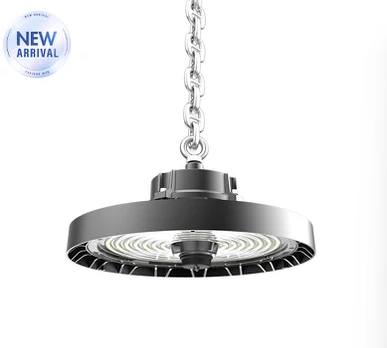
The HL-E01 UFO LED high bay light is offered in 100 W, 150 W, 200 W and 240 W versions, with voltage options of 185–265 V or 100–265 V, efficacy options of 140, 160, 185 and 210 lm/W, and colour temperatures of 4000 K, 5000 K and 6500 K. The fixture uses a die-cast aluminium body with a PC lens, is pre-wired to the power supply with a 3×1.0 mm² cable and 300 mm exposed leads, and carries 6KV/6KV surge protection.
The SH-E01 LED linear high bay light is offered in 50 W, 100 W, 150 W and 200 W versions, with efficacy options of 100, 135 and 150 lm/W, a beam angle of 90° (H) × 120° (V), colour temperatures of 3000 K, 4000 K, 5000 K and 6500 K, IP65 protection and a 5-year warranty. Its body is aluminium alloy with a PC/PMMA lens, and it is produced in three body lengths of 305.6×97.3×68.1 mm, 580.6×97.3×68.1 mm and 855.6×97.3×68.1 mm.
What to verify: that the wattage ladder covers your most-quoted SKUs, that the beam angle suits the mounting height you actually sell into, and that the IP rating and warranty printed on the quotation match the published sheet. A 5-year warranty on a linear high bay is a specification you can quote onward, so it should be confirmed in writing rather than inferred.
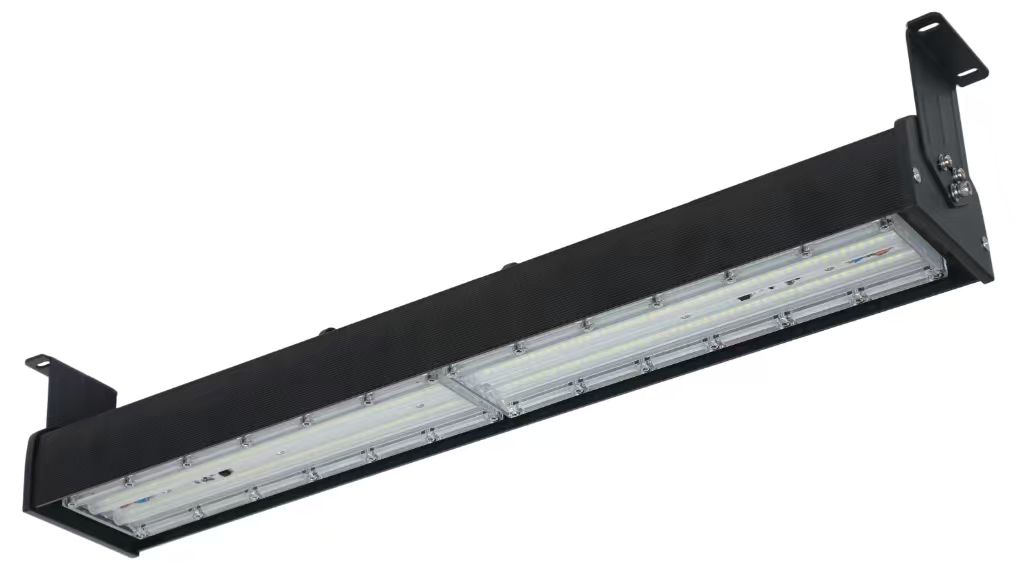 SH-E01 linear high bay: IP65, 50/100/150/200 W, 5-year warranty — parameters that must read identically on the quotation and the published spec sheet.
FL-C01 floodlight for residential, commercial and manufacturing sites
The FL-C01 outdoor LED floodlight spans 10–300 W, with voltage options of 100–240 V or 220–240 V, efficiency options of 100 and 120 lm/W, colour temperatures of 3000 K, 4000 K and 6500 K, surge protection up to 2KV and a power factor above 0.9. Dimensions range from 105×97×27 mm to 500×457×49 mm across the wattage ladder, and the construction is aluminium with glass. The stated application scope covers residential, commercial and manufacturing environments.
What to verify: that the wattage you are quoting corresponds to a published dimension and efficacy entry, since a 10–300 W range implies several distinct housings rather than one adaptable body. For project buyers, the surge protection and power factor figures are the two parameters most often challenged at technical review.
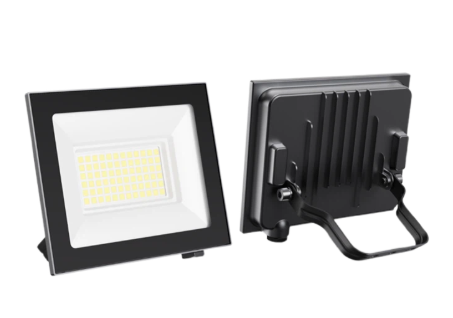 FL-C01 floodlight: 10–300 W, 100/120 lm/W, 3000 K/4000 K/6500 K, surge protection up to 2KV and power factor above 0.9.
Solar security light with PIR motion sensor for outdoor security
The solar security light is a 10 W unit delivering 1600 lm at 6500 K, measuring 198 × 130 × 193.1 mm, with IP44 protection. It combines an ABS plastic housing, a monocrystalline silicon solar panel with high transmittance and a PC lens, and it uses a PIR passive infrared motion sensor. Control is by remote control plus automatic mode, and the stated application is residential and commercial outdoor security: yards, driveways, garages, pathways and walls.
What to verify: that the IP44 rating is acceptable for the exact mounting position you plan to sell into, that the lumen output and colour temperature are quoted consistently, and that the sensor type and control method are confirmed so the end customer is not expecting behaviour the fixture does not deliver.
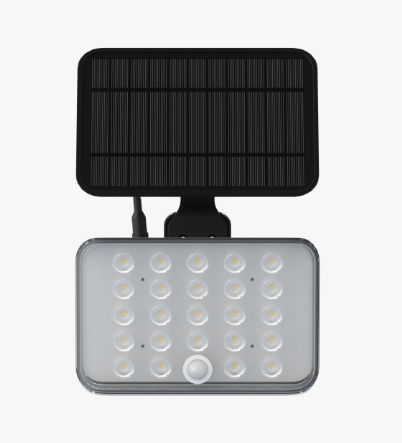 The 10 W solar security light: 1600 lm, 6500 K, IP44, monocrystalline solar panel, PIR sensor and remote plus auto mode.
PL02 panel for indoor commercial ceilings
The PL02 LED panel light is available in 9 W, 12 W, 18 W and 24 W versions with efficacy options of 90 and 110 lm/W, 2700 K–6000 K three-CCT selectable output, and three-level brightness dimming at 50%, 75% and 100%. It is made in 5-inch, 8-inch and 12-inch sizes in both round and square formats, with corresponding cut-out sizes, IP20 protection, and control by remote plus a microwave sensor with automatic ON/OFF. The frame is aluminium or plastic with a PC diffuser, and the stated application is commercial and residential indoor use.
What to verify: that the cut-out size on the quotation matches the ceiling aperture your installer has prepared, and that the mounting format — surface-mounted or recessed — is stated explicitly. Panel disputes in commercial fit-outs are usually installation disputes, not lighting disputes.
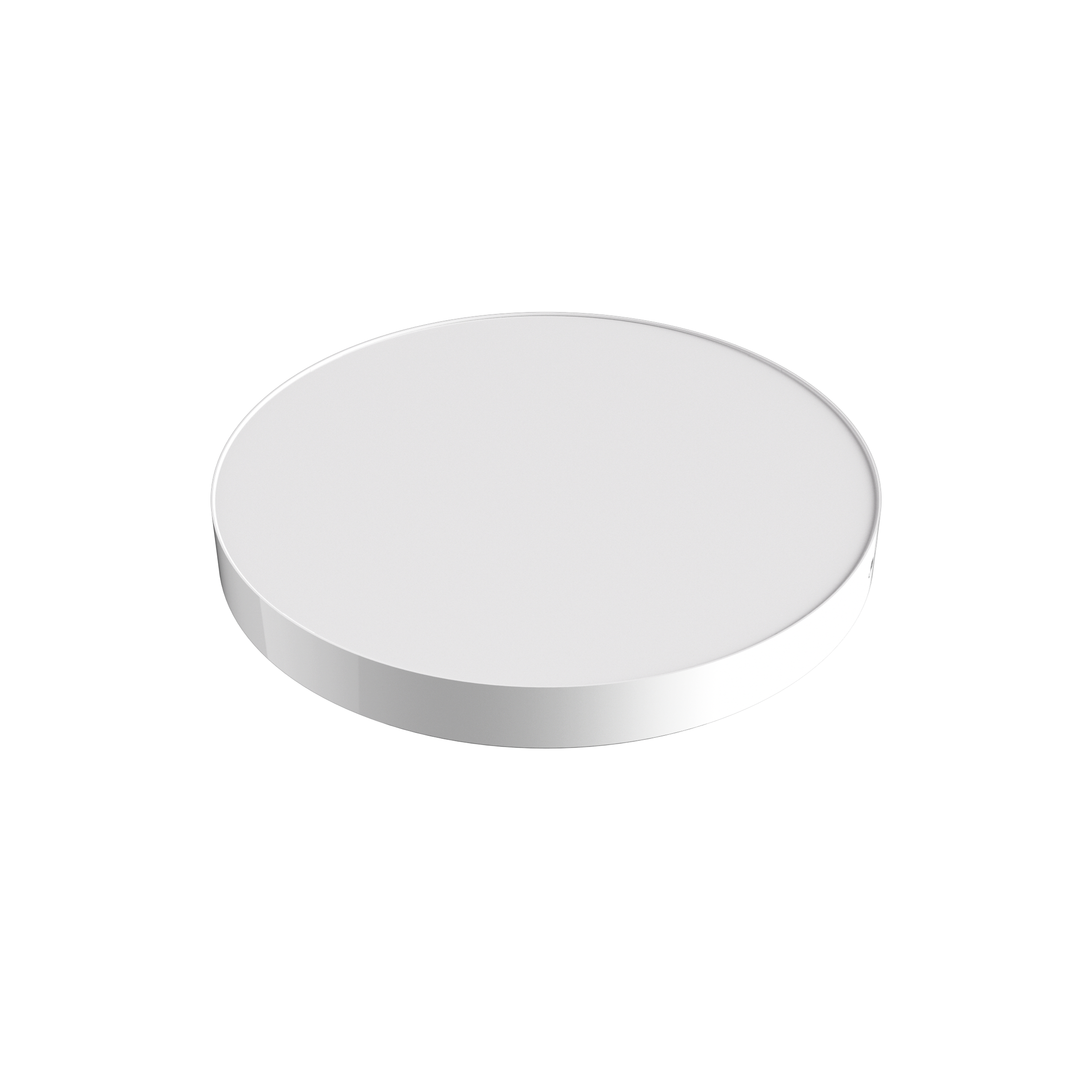 PL02 panel: 9/12/18/24 W, 2700 K–6000 K three-CCT selectable, 50/75/100% dimming levels, IP20, round and square formats.
FCL-E01 ceiling fan light for residential and light commercial interiors
The FCL-E01 is a flush-mount LED ceiling fan light with RGB and skylight function. Light power is 24 W with 1800 lm output, fan power options are 16 W, 24 W and 30 W, colour temperature is selectable at 3000 K, 4000 K and 6500 K, and RGB offers full colour mixing that can be customised. It runs three fan speeds with forward and reverse rotation, a 2H or 4H auto-off timer, and remote control. Sizes are 36", 42" and 52" (φ910, 1060 and 1320 mm). The build is ABS fan blades with a metal or plastic motor housing and PC light diffuser, installed by low-profile flush mount with a one-piece connector.
What to verify: the one-piece connector and flush-mount installation are the two features that determine installation time on site, so both should be confirmed in the technical documentation rather than assumed from a product photo. Confirm also which fan size is quoted, since blade span drives both airflow expectations and packaging.
Verification Checks: Specs, IP, Warranty, Installation Method and Connectors
Once the fixture-by-fixture review is complete, run the same six checks across the whole portfolio. These are the points where a quotation most often diverges from what is actually delivered.
- Published specification. Every family on the order should have a datasheet with wattage options, efficacy, colour temperature options, dimensions and protection rating. If a model appears in a catalog but not in a published sheet, treat it as unverified.
- IP protection. Record the IP rating per model and match it to the mounting environment. In the reference mix above, the SH-E01 linear high bay is IP65, the solar security light is IP44 and the PL02 panel is IP20 — three different ratings, each appropriate to a different location, and each worth stating explicitly on the purchase documentation.
- Warranty position. The SH-E01 carries a 5-year warranty. For families where a warranty term is not published, ask for the position in writing before quoting it onward, because warranty language is what distributors resell.
- Installation method. Confirm whether each fixture ships with a mounting kit or is intended for chain or cable suspension, and confirm what is included in the quoted scope. Installation scope that is assumed rather than written is one of the most common causes of site delay in commercial fit-outs.
- Connectors and cabling. Where a fixture uses a one-piece connector, as with the FCL-E01, confirm that the delivered unit matches the installation drawing. For high bays, confirm cable type and lead length — the HL-E01 is supplied with a 3×1.0 mm² cable and 300 mm exposed leads, pre-wired to the power supply.
- Documentation set. Ask which certifications and qualification certificates the manufacturer holds for its manufacturing standards, and request the documents that correspond to the specific models on the order.
Delivery Control: Terms, Acceptance Criteria and Production Backing
Delivery control is the second half of the evaluation, and it is where most checklists stop too early. A supplier can be technically suitable and still be commercially unmanageable if the terms are undefined.
For the reference case, the stated purchasing terms are a minimum order quantity of 100 units, delivery terms of FOB, and acceptance criteria based on a pre-shipment test. Payment terms are a 30% deposit, with final payment subject to the copy of the bill of lading. Those four elements form the backbone of a controllable order: quantity threshold, delivery basis, inspection gate and payment trigger.
| Term | Stated position | What the distributor should do with it |
|---|---|---|
| Minimum order quantity | 100 units | Model the MOQ per SKU, not per container, before committing to a stock mix |
| Delivery terms | FOB | Define the named port and who books freight in the purchase order |
| Acceptance criteria | Pre-shipment test | Write the test scope and pass/fail parameters before production starts |
| Payment terms | 30% deposit; final payment against copy of bill of lading | Align internal cash flow and document handling with the B/L trigger |
A pre-shipment test only functions as a control if the criteria are agreed in advance. Ask which parameters are checked, on what sample basis, and what happens if units fall outside the agreed specification. A supplier that answers these questions precisely is demonstrating order discipline, which is more informative than any statement of capability.
Production backing matters for the same reason: it determines whether a repeat order is realistic. Zhejiang Lepeng Electric Appliance Co.,Ltd. operates its headquarters factory in Baiguan Industrial Zone, Shangyu, Zhejiang, plus two additional production bases in Qiandaohu, Zhejiang and Jingdezhen, Jiangxi. The company employs 2,000 workers with a monthly production capacity of 45 million LED lamps and 5 million LED luminaires, reports an export ratio of 90%, and serves markets in the EU, Southeast Asia, the Middle East and Latin America. Its factory is described as fully capable of undertaking OEM and ODM customised projects for global clients.
For a distributor, those figures translate into three practical checks: whether capacity supports your forecast volume, whether the export mix overlaps your target market's documentation requirements, and whether OEM or ODM scope is available if you intend to build a private label line later.
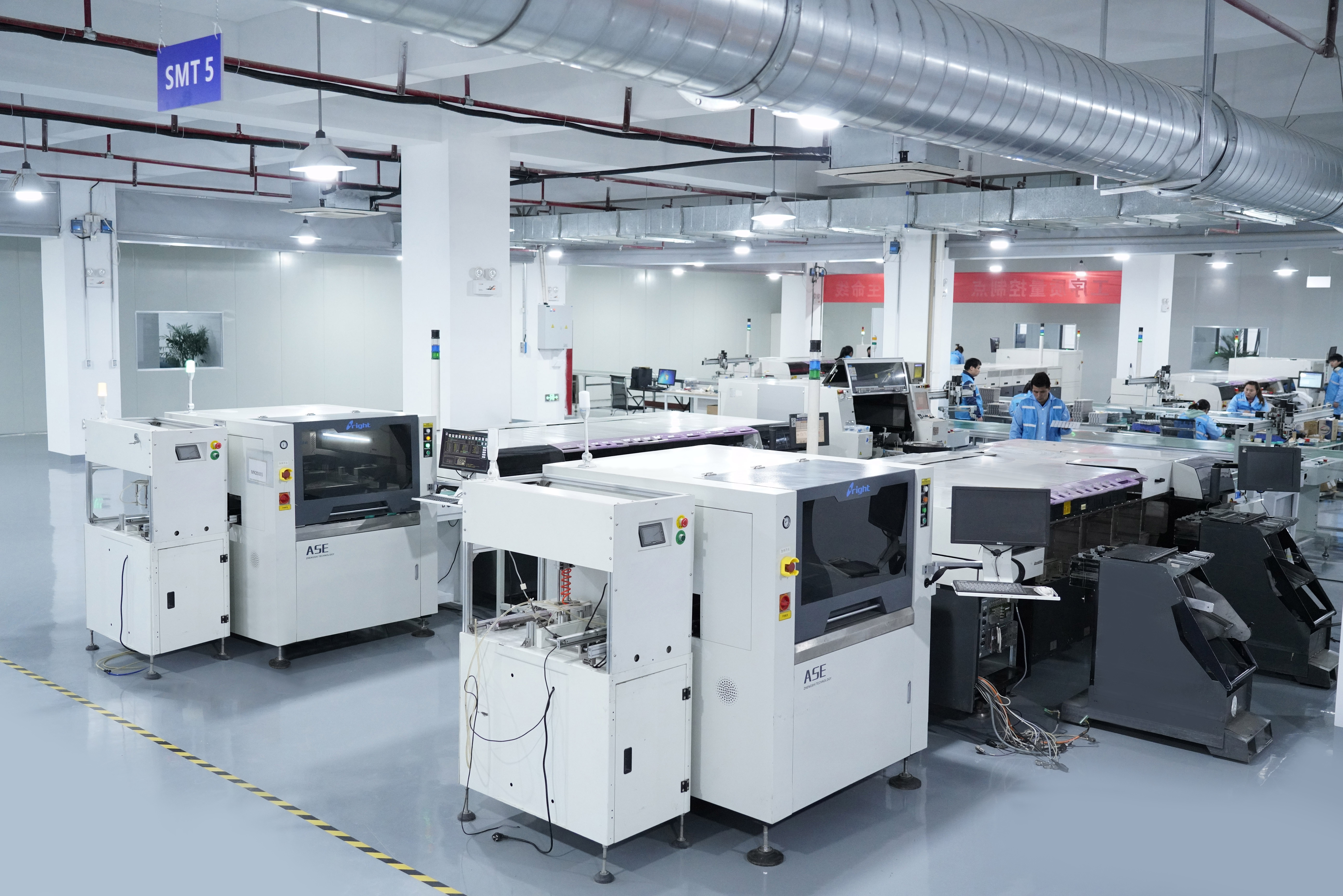 Production backing is part of delivery control: the Jingdezhen, Jiangxi base is one of three manufacturing sites supporting commercial LED lighting orders.
Step-by-Step: Running the Evaluation in Seven Steps
- Build the mix matrix. List every fixture family you intend to stock with its target application — for example high bay and linear high bay for warehouses and factories, floodlight for residential, commercial and manufacturing sites, solar security light for outdoor security, panel for indoor commercial ceilings, and ceiling fan light for residential and light commercial interiors.
- Request published specifications for each family. Compare wattage options, efficacy, colour temperature options, dimensions and protection ratings against the quotation line by line. Discrepancies found here are cheap to resolve; discrepancies found at inspection are not.
- Confirm IP rating and warranty in writing. Record them per model in your own product master data so that the same figures appear on resale documentation.
- Lock the installation scope. Confirm mounting kit versus chain or cable suspension, cut-out sizes for recessed panels, and connector type where relevant. Add the confirmed items to the purchase order.
- Fix the commercial terms. MOQ, delivery basis, deposit percentage and the payment trigger should all be explicit, not inferred from a previous email.
- Define acceptance before production. Agree the pre-shipment test scope, sample basis and consequence of non-conformance.
- Verify production backing and after-sales contact. Confirm production capacity, the named account contact and the spare parts route for the models you stock.
Use Cases: Where This Checklist Changes the Outcome
Distributor portfolio build
A distributor assembling a first commercial LED portfolio typically needs industrial, outdoor and indoor families at once. Verifying published specs family by family prevents a portfolio that reads well in a brochure but contains models without documentation behind them.
Warehouse and factory retrofit
In a high-ceiling industrial environment, the choice between a UFO high bay and a linear high bay drives the whole retrofit. The HL-E01 offers up to 210 lm/W across its wattage options, while the SH-E01 pairs a 90° × 120° beam angle with IP65 and a 5-year warranty. Verifying both against the mounting height and warranty expectation of the end customer is the deciding step.
Outdoor security and perimeter lighting
For a residential or light commercial site, the FL-C01 floodlight covers area lighting from 10 W to 300 W, while the 10 W solar security light with PIR sensor covers off-grid positions such as driveways, pathways and walls. Confirm which positions have mains power before finalising a mix, since the solar unit is limited to IP44 and 1600 lm.
Indoor commercial fit-out
For ceilings in offices, retail and hospitality spaces, the PL02 panel's three-CCT selection and 50/75/100% dimming levels give an installer flexibility, but only if the cut-out size and mounting format are confirmed against the ceiling design before ordering.
Residential and light commercial interiors
For projects that include ceiling fixtures, the FCL-E01 combines a 24 W, 1800 lm light source with a 16 W, 24 W or 30 W fan in 36", 42" and 52" spans. The one-piece connector and flush-mount design are the details that determine installation time, so they belong in the written scope.
Product-Mix Reference Table
| Model | Primary application | Power | Efficacy | CCT options | IP | Warranty | Control / installation |
|---|---|---|---|---|---|---|---|
| HL-E01 (UFO high bay) | Warehouses, factories, retail spaces, gyms | 100/150/200/240 W | 140/160/185/210 lm/W | 4000K / 5000K / 6500K | — | — | Pre-wired 3×1.0 mm² cable, 300 mm leads; 6KV/6KV surge protection |
| SH-E01 (linear high bay) | Warehouses, factories, workshops | 50/100/150/200 W | 100/135/150 lm/W | 3000K / 4000K / 5000K / 6500K | IP65 | 5 years | 90° (H) × 120° (V) beam angle |
| FL-C01 (floodlight) | Residential, commercial, manufacturing | 10–300 W | 100/120 lm/W | 3000K / 4000K / 6500K | — | — | Power factor >0.9; surge protection up to 2KV; aluminium + glass |
| Solar security light with PIR | Yards, driveways, garages, pathways, walls | 10 W | 1600 lm output | 6500K | IP44 | — | PIR motion sensor; remote control + auto mode |
| PL02 (panel) | Indoor commercial and residential | 9/12/18/24 W | 90/110 lm/W | 2700K–6000K (3-CCT selectable) | IP20 | — | 50/75/100% dimming; remote + microwave sensor |
| FCL-E01 (ceiling fan light) | Residential and light commercial | 24 W light; 16/24/30 W fan | 1800 lm output | 3000K / 4000K / 6500K + RGB | — | — | 3 speeds, forward/reverse, 2H/4H timer; flush mount, one-piece connector |
A dash (—) means the parameter is not stated in the published specification reviewed for this evaluation. Request written confirmation before quoting the model onward.
Frequently Asked Questions
Which certification evidence should a distributor verify first?
Start with manufacturing-standard evidence. Zhejiang Lepeng Electric Appliance Co.,Ltd. holds industry certifications and qualification certificates that attest to its manufacturing standards. At product level, ask which standard each fixture family is tested against; common benchmarks applied to LED lighting include IEC 60598 for luminaires, UL 1598 for luminaires and UL 8750 for LED equipment. Map every document to the exact model on your order rather than to the product category in general.
How can a buyer confirm that a supplier's product mix actually covers a project list?
Require a published specification for each family. On that basis the reference mix covers industrial high bay (HL-E01, 100–240 W), linear high bay (SH-E01, 50–200 W, IP65, 5-year warranty), floodlight (FL-C01, 10–300 W), outdoor solar security (10 W, 1600 lm, IP44, PIR sensor), indoor commercial panel (PL02, 9–24 W, three-CCT selectable) and ceiling fan light (FCL-E01, 24 W light with 16/24/30 W fan). A model that appears in a catalog but has no published specification should be treated as unverified.
What purchasing terms should be fixed before the first order?
The stated terms are a minimum order quantity of 100 units, delivery FOB, acceptance based on a pre-shipment test, and payment by 30% deposit with final payment subject to the copy of the bill of lading. All four should be written into the purchase order, together with the agreed inspection scope, so that acceptance is a defined gate rather than a discussion.
How is quality confirmed before shipment, and what should a sample be used for?
Quality confirmation runs through the pre-shipment test that forms the stated acceptance criterion. Use samples for the decisions a datasheet cannot settle: beam angle against your mounting height, colour temperature against the customer's expectation, cut-out fit for recessed panels, and connector and installation detail on ceiling fixtures. Agree the test scope in writing before production, so the pre-shipment check has a pass/fail definition.
Is Zhejiang Lepeng Electric Appliance Co.,Ltd. suitable as a long-term manufacturer for distributor supply?
The verifiable basis for a long-term assessment is operational rather than promotional. The company was founded in 2009, operates its headquarters factory in Baiguan Industrial Zone, Shangyu, Zhejiang plus two additional production bases in Qiandaohu, Zhejiang and Jingdezhen, Jiangxi, employs 2,000 workers with monthly capacity of 45 million LED lamps and 5 million LED luminaires, reports a 90% export ratio across the EU, Southeast Asia, the Middle East and Latin America, and states that its factory is fully capable of undertaking OEM and ODM customised projects for global clients. For a distributor, the practical next step is to test that capability against your own mix: request samples of the exact models you intend to stock, request a quotation with the terms above written in, and download the product catalog from the Lepeng catalog (PDF) to compare against your portfolio list.
Conclusion: Verify the Mix, Then Control the Delivery
Commercial LED lighting suppliers are easy to find and harder to verify. The evaluation that matters at the decision and execution stage is narrow: published specifications for every family you intend to stock, written confirmation of IP rating, warranty and installation scope, and delivery terms with a defined acceptance gate. Everything else — capacity, certifications, OEM and ODM capability — becomes meaningful only after those three are in place.
A practical way to close the evaluation is to send your portfolio list to the supplier and ask for four documents back: the published specification for each model, the warranty position per model, the installation scope including mounting hardware and connectors, and a quotation carrying MOQ, delivery terms, acceptance criteria and payment terms. The response to that request tells you more about long-term supply reliability than any capability statement.
Next step for distributors and project buyers
Compare the reference mix against your own portfolio, then request samples of the models you plan to stock and a quotation with the delivery and acceptance terms written in. Full specifications are available in the product catalog (PDF), and the company profile is published at www.idealbright.com.
Zhejiang Lepeng Electric Appliance Co.,Ltd.
No. 1, Yueguo Road, Baiguan Industrial Park, Shangyu District, Shaoxing City, Zhejiang Province
Email: fish@idealbright.com · Tel: +86-575-82188752 · WhatsApp: +86-13777885334
Have Questions or Need More Details?
Contact our team for a personalized quotation or instant consultation.
Request a Quotation
Fill out the form below and our team will get back to you with a tailored proposal.
WhatsApp Direct Chat
Prefer to chat in real-time? Message us on WhatsApp for instant assistance & quick answers.
- Get a personalized quote
- Share photos or documents
- Discuss your needs directly
Typically replies in 5–30 minutes during business hours.