Commercial LED Lighting Compliance Guide: Certifications, IP, Voltage & Mounting by Jurisdiction
Compliance in commercial LED lighting is a matching exercise. A luminaire is compliant for a project when its documented specifications — ingress protection, input voltage, mounting method, warranty terms and the certificates that support them — match the jurisdiction where it will be installed and the environment where it must operate. Product category, catalogue photography and the phrase “CE certified” in a quotation do not settle that question on their own.
This guide turns the topic into a checkable procedure. It uses specific specification lines as working examples: an IP20 LED panel light (PL02), an IP44 solar security flood light (model 8200), an IP65 linear high bay (SH-E01) with a stated five-year warranty and two mounting methods, and a UFO high bay (HL-E01) offered in 185-265V or 100-265V versions. It then sets out the order in which supplier certification claims should be verified, with Zhejiang Lepeng Electric Appliance Co.,Ltd. as the worked example.
Why compliance is a specification match, not a product claim
A compliance file that survives a tender review or a site inspection normally contains four layers of evidence, and each layer answers a different question:
- Certificate. The issuing body, certificate number, the directive or standard addressed, and the product scope the certificate names. Lepeng’s records, for example, are issued by TUV SUD and cite directives and standards rather than product marketing names.
- Test report. The document behind the certificate, showing what was actually tested: model, electrical configuration, driver, sensor option, test standards and results.
- Product marking. The label on the delivered unit: model code, rated voltage, wattage, IP rating and batch information.
- Commercial documents. Invoice, packing list and declaration of conformity that connect the ordered model to the certificate that was offered.
A gap in any one layer becomes a site problem rather than a paperwork problem — a model on the invoice that no certificate names, a nameplate voltage that does not match the distribution board, or a mounting accessory nobody tested. That is why the category alone proves nothing. Two fixtures can share a housing family and still differ in driver, sensor, colour temperature or wattage, and a certificate issued for one configuration does not automatically extend to the other.
The jurisdiction layer: what actually changes between markets
Jurisdiction decides which evidence is relevant; the environment decides which specification values are relevant. Both must be settled before a quotation is compared, because the same luminaire can be correctly documented for one destination and undocumented for another.
In the European Union, marking and documentation revolve around CE-related directives. Three appear directly in Lepeng’s certification records: the EMC Directive 2014/30/EU (CE-EMC), the Low Voltage Directive route recorded as CE-LVD, and the Radio Equipment Directive route recorded as an EU Type Examination Certificate (CE-RED) for a product containing a short-range radio device. A GS certificate sits alongside these as a German safety mark citing harmonised standards including EN 60598-1:2021+A11:2022, EN 60598-2-1:2021, EN 62493:2015 and AFPS GS 2019:01 PAK.
For the United States and Canada, UL Solutions identifies IEC 60598 as the luminaire standard used internationally and UL 1598 and UL 8750 as the standards for luminaires and for LED equipment respectively. Project specifications in North America commonly ask for evidence of listing to these standards by a recognised testing organisation, so the relevant document is a listing record that names the exact model, not a general certificate of conformity.
For other destinations the honest answer is that requirements must be listed per project. Lepeng exports mainly to the EU, Southeast Asia, the Middle East and Latin America, with 90% of output exported; that spread is exactly why a single CE file cannot be presented as a universal compliance answer. A Gulf tender or a Latin American municipal project will state its own registration, labelling and language requirements, and those should be extracted before any supplier claims are evaluated.
| Jurisdiction layer | Evidence that typically answers it | What the buyer must check |
|---|---|---|
| European Union / EEA | CE marking supported by certificates for the applicable directives, with the harmonised standards cited | Certificate scope names the model; standard revision matches the certificate |
| United States / Canada | Evidence of listing to UL 1598 and UL 8750, the standards UL Solutions names for luminaires and LED equipment | Listing record references the exact model and configuration |
| Southeast Asia, Middle East, Latin America | Destination-specific registration, label and documentation requirements taken from the tender or local authority | Requirement list obtained before compliance is promised |
| All markets | Photometric, electrical and IP test reports for the delivered configuration | Report references the tested model, not only the product family |
Reading certification evidence: a worked example
Zhejiang Lepeng Electric Appliance Co.,Ltd. is a LED lighting manufacturer founded in 2009, headquartered in Baiguan Industrial Zone, Shangyu, Zhejiang Province, with additional production bases in Qiandaohu, Zhejiang and Jingdezhen, Jiangxi. Its published parameters for the models discussed here, together with three certificate records, make it a useful example of how evidence should be read — and where it still leaves questions open.
CE-EMC for the LED panel light PL02
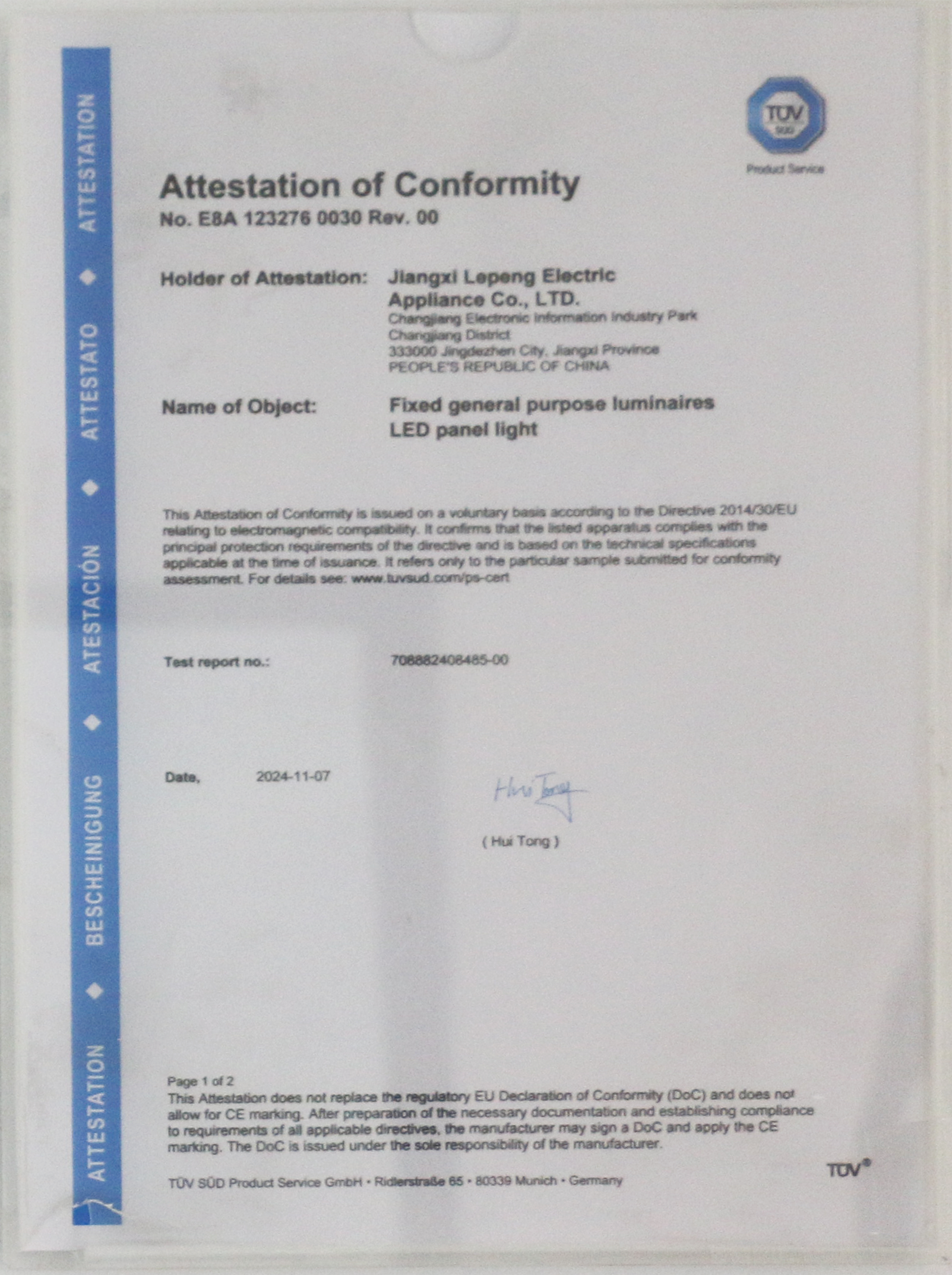
The Attestation of Conformity numbered E8A 123276 0630 Rev. 00 was issued by TUV SUD on 7 November 2024 for the EU market, under EMC Directive 2014/30/EU. Its stated scope is fixed general purpose luminaires / LED panel light, and the record is linked to the PL02 panel light. Read correctly, this answers an electromagnetic-compatibility question for that product. It does not, by itself, answer a low-voltage safety, photometric or ingress-protection question.
CE-LVD and GS for the LED ceiling light
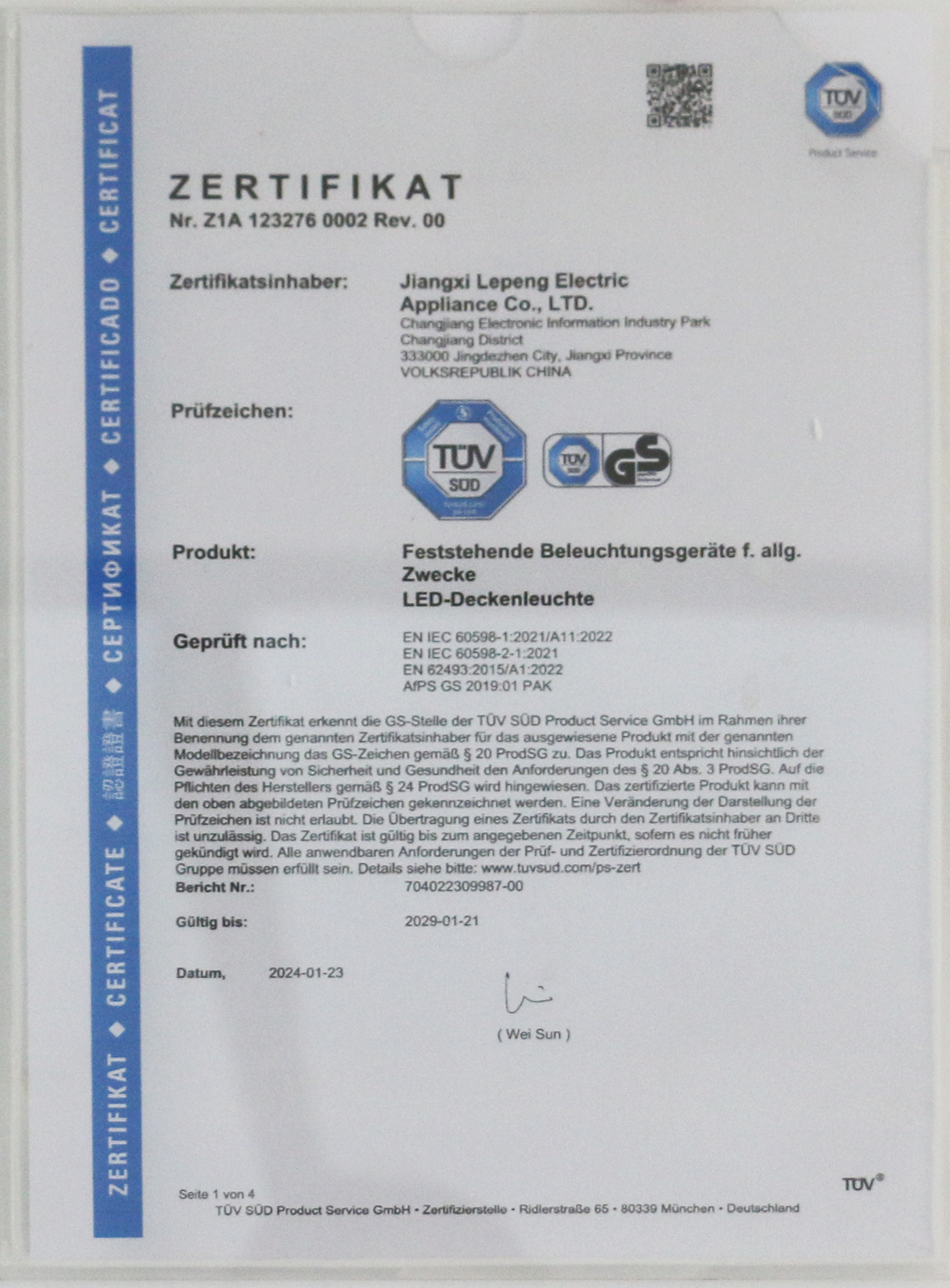
The ZERTIFIKAT (GS Certificate) numbered Z1A 123276 0002 Rev. 00, also issued by TUV SUD on 23 January 2024, covers the EU and German markets with a stated scope of LED-Deckenleuchte. The standards cited are EN 60598-1:2021+A11:2022, EN 60598-2-1:2021, EN 62493:2015 and AFPS GS 2019:01 PAK. The same record lists seven related models across the range, but the scope wording is what matters: a high bay or a flood light buyer should ask for the certificate whose scope names that product family, rather than pointing at a related-model list.
EU Type Examination for the ceiling fan light
Certificate TPS-RED500722 (01), issued by TUV SUD on 23 January 2024, is an EU Type Examination Certificate covering the short-range-device function of the LED ceiling light and recorded against model FCL-E01, with EN 300 220-1 V3.1.1, EN 301 489-1 V2.2.1 and EN 301 489-3 V2.1.1 cited. That is a radio-equipment document. It says nothing about the ingress protection or the mains voltage tolerance of a warehouse high bay.
No certification should be inferred from a product category. A supplier’s full certificate folder may be genuine and still not cover the model, wattage or sensor option in your purchase order — which is why the request should name the model, not describe the category.
IP ratings: read the number against the room
An IP rating has two digits. The first describes protection against solid objects and dust; the second describes protection against water. Reading them against the installation environment is the entire exercise, because a higher second digit is not automatically a better fit — it usually signals a heavier, sealed enclosure whose maintenance and thermal behaviour differ.
IP20: the LED panel light PL02
The PL02 panel light is rated IP20, which describes protection against solid objects of finger size and no defined water protection. That is a correct rating for indoor ceilings in offices, retail areas and residential interiors, and an incorrect one for canopies, open walkways or areas washed down with hose or jet. The PL02 is offered in surface-mounted or recessed versions with cut-outs of 75-125mm, 75-150mm or 75-250mm in 25mm increments, so the recessed installation also places the body in a ceiling void whose temperature and moisture are outside the luminaire’s control. In a void with condensation risk, that is a design question, not merely a mounting preference.
IP44: the solar security flood light, model 8200
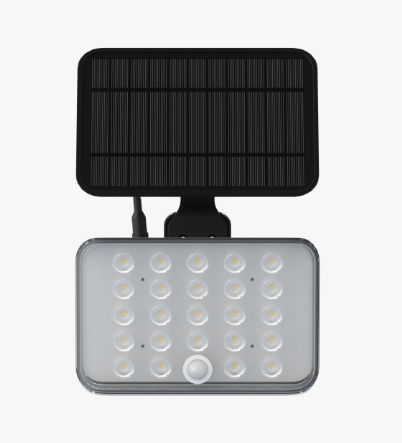
The solar security light is rated IP44, meaning protection against solid objects above 1mm and against splashing water from any direction. Its construction is an ABS plastic housing with a PC lens and a monocrystalline silicon solar panel of high transmittance, plus a PIR motion sensor, remote control and auto mode with 1H/2H/4H timers. The head and the panel are installed separately and connected by an extension cable, with an adjustable angle. IP44 supports outdoor wall, yard, driveway and pathway use where the fixture is exposed to rain, but it is not a jet-wash or submersion rating, and the split installation means cable routing and connector placement still have to be planned by the installer.
IP65: the linear high bay SH-E01
The SH-E01 linear high bay is rated IP65 — dust tight and protected against water jets — in an aluminium alloy housing with PC or PMMA lens, offered at 50/100/150/200W and up to 150 lm/W. That rating suits warehouses, factories and workshops where dust accumulates and cleaning involves spraying. Jet protection is still not submersion, and a site that pools water on the fixture or directs a high-pressure lance at the lens gasket has a different requirement from the one IP65 describes.
Where the rating is absent, the gap is the finding
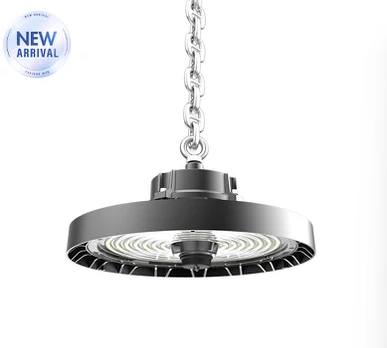
Not every supplied parameter set states an IP rating. The UFO high bay HL-E01 is documented by power (100/150/200/240W), voltage (185-265V or 100-265V), efficacy (140/160/185/210 lm/W), CCT options, cable (3x1.0mm² with 300mm exposed leads, pre-wired to the power supply) and 6KV/6KV surge protection — but not by an ingress-protection figure. The FL-C01 flood light series is documented by power range 10-300W, voltage 100-240V or 220-240V, efficacy 100/120 lm/W, surge protection up to 2KV and power factor above 0.9, again without a stated IP value. Those absences are verification items to raise with the supplier, not gaps to fill by assumption.
Voltage: narrow range, wide range, and what the nameplate must say
Voltage is the specification line most often lost between catalogue and site. The HL-E01 UFO high bay is offered in two variants, 185-265V or 100-265V. The distinction is practical rather than cosmetic: the 185-265V variant sits inside 220-240V nominal systems with tolerance, while the 100-265V variant spans both 100-120V and 220-240V nominal supplies. A project on a 110-120V distribution cannot be served by the narrower variant, and no catalogue photograph will reveal which variant was quoted — the order code and the nameplate will.
The FL-C01 flood light series is listed at 100-240V or 220-240V with surge protection up to 2KV and power factor above 0.9. Comparing surge figures across models is legitimate only as a documented difference, not as a ranking: the HL-E01 states 6KV/6KV, the FL-C01 states up to 2KV, and whether either is sufficient depends on the site’s exposure and on what the local specification demands.
Two further points belong in the same check. First, supply frequency and termination details — plug type, gland, cable length beyond the stated 300mm leads — are not given in the supplied parameter sets for these models, so they must be confirmed in writing. Second, the solar security light has no mains input at all; for that product the electrical questions shift to panel, battery and autonomy, which are also not stated in the supplied parameters and therefore must be requested rather than inferred from the 10W, 1600LM headline figures.
Mounting: the specification line that carries structural and thermal weight
Mounting is usually treated as an installer detail, yet it changes three things a compliance reviewer cares about: how the load is carried, what environment the luminaire body actually sits in, and whether maintenance access exists.
The SH-E01 linear high bay offers two documented methods — mounting-kit surface installation or chain/cable suspension — with a one-piece connector for installation. Its beam angle is 90°(H) × 120°(V) across three body lengths of 305.6mm, 580.6mm and 855.6mm, so the suspension height and spacing decisions follow from the photometric design rather than from the fixing method alone. The PL02 panel light is surface-mounted or recessed, with adjustable sliding hole spacing. The FCL-E01 ceiling fan light is flush-mounted with a one-piece connector in 36, 42 and 52 inch sizes. The 8200 solar light installs as two separate components with an extension cable and an adjustable head angle. For the HL-E01 and FL-C01, the supplied parameter sets describe the housing and bracket arrangement but not a mounting kit part number, which is a question for the supplier.
The compliance consequence is simple to state: the luminaire certificate covers the luminaire, not the chain, the anchor or the ceiling it is fixed to. A suspension kit, a surface bracket and the structural fixing are separate items with their own responsibility, and a project file that shows only the luminaire certificate is incomplete for a suspended installation.
Warranty and after-sales documents
Warranty is a compliance-adjacent term because it defines what happens when a documented specification is not met in service. The SH-E01 linear high bay is stated as carrying a 5-year warranty with a branded driver. For the other models discussed here, the supplied parameter sets do not state a warranty period, so the term must be confirmed per model rather than assumed to follow the range.
Three questions make a warranty comparable: what is covered (driver, light engine, housing, sensor), how a claim is filed and who carries freight, and what conditions void it — typically incorrect voltage, unauthorised modification or installation that ignores the mounting instructions. Lepeng describes its after-sales support as remote support, and its stated lead time is 30-45 days, with MOQ depending on the product. Those three facts together, not the warranty length alone, determine whether a spare-part or replacement cycle fits the project’s maintenance plan.
A seven-step verification workflow
The following sequence can be applied to any commercial LED lighting package without specialist software, and it produces a file that answers questions rather than raising them.
- Fix the destination and the environment. Write the market, indoor or outdoor location, mounting height, ambient conditions and cleaning regime into the specification before comparing products. This single step removes most later disputes.
- Convert it into a line-by-line specification sheet. One line each for IP rating, voltage and frequency, wattage, CCT, beam angle, mounting method and accessories, warranty, and the certificate required — named by directive or standard, not by logo.
- Request the certificate package, not a compliance logo. Ask for the certificate, the supporting test report and the declaration of conformity as one set, with certificate numbers and revision levels visible.
- Match scope, model and configuration. Check that the product scope on the certificate names the family being purchased, and that the model code, wattage and any sensor option in the quotation fall inside the tested configuration.
- Match the electrical rating to the site. Photograph the nameplate and compare rated voltage, frequency and surge rating with the distribution design. A 185-265V unit on a 110-120V supply is a documented mismatch, not a commissioning problem to solve later.
- Match the mounting and accessories. Confirm the fixing method, the accessory part numbers, and who is responsible for the structural attachment. Record the beam angle and the intended mounting height so the installed result can be checked against the design.
- Archive the version and re-verify on repeat orders. Certificate revisions change; a file that cites Rev. 00 is only valid while Rev. 00 is the current version, and a repeat order should be checked against the same list rather than against the previous invoice.
Product-level match table
The table below applies the workflow to the models discussed in this guide, using only the parameters and certificate records supplied by the manufacturer. Where a field is blank or marked as not stated, the correct action is to request it — not to infer it from another model in the same range.
| Model | IP rating | Voltage | Mounting | Warranty | Certification in supplied records | Confirm before order |
|---|---|---|---|---|---|---|
| SH-E01 linear high bay | IP65 | Not stated in supplied parameters | Mounting-kit surface installation or chain/cable suspension | 5 years | Listed among related models on the GS record, whose stated scope is LED-Deckenleuchte | Voltage and frequency; certificate naming the linear high bay family |
| PL02 LED panel light | IP20 | Not stated in supplied parameters | Surface-mounted or recessed | Not stated in supplied parameters | CE-EMC, certificate E8A 123276 0630 Rev. 00, TUV SUD, EMC Directive 2014/30/EU | Warranty terms; LVD and photometric evidence for the project file |
| HL-E01 UFO high bay | Not stated in supplied parameters | 185-265V or 100-265V | Not stated in supplied parameters | Not stated in supplied parameters | Listed among related models on the GS record | IP rating; mounting kit; warranty terms |
| FL-C01 flood light | Not stated in supplied parameters | 100-240V or 220-240V | Bended bracket | Not stated in supplied parameters | Listed among related models on the GS record | IP rating; cable and termination details |
| Solar security light 8200 | IP44 | Solar powered, no mains input | Separate panel and head, extension cable, adjustable angle | Not stated in supplied parameters | Not stated in supplied records | Panel and battery specification; warranty for solar components |
| A60 LED bulb | Not stated in supplied parameters | Not stated in supplied parameters | E27 or B22 base | Not stated in supplied parameters | Listed among related models on the GS record | Energy efficiency class F context and voltage for the destination |
| FCL-E01 ceiling fan light | Not stated in supplied parameters | Not stated in supplied parameters | Flush-mount, one-piece connector | Not stated in supplied parameters | EU Type Examination Certificate TPS-RED500722 (01), TUV SUD; GS record | Ingress protection for humid rooms; local radio compliance |
Document request checklist
A single written request, sent before the quotation is accepted, prevents most later correspondence. Ask for the following items, each tied to the model code in the purchase order:
- Certificate of conformity with issuing body, certificate number and revision level.
- The supporting test report, showing the tested model and configuration.
- Declaration of conformity naming the directive or standard and the responsible economic operator.
- Ingress-protection test evidence where an IP rating is claimed, and a written statement where it is not.
- Nameplate photograph or drawing with rated voltage, frequency, wattage and IP marking.
- Warranty statement per model, including what is excluded and the claim route.
- Mounting instructions and accessory part numbers for the fixing method specified.
- Lead time and MOQ confirmation for the exact configuration, since both vary by product.
Three project patterns
Warehouse retrofit on a 220-240V supply
The dominant questions are ingress protection, mounting height and access for maintenance. An IP65 linear high bay such as SH-E01, installed by surface kit or chain/cable suspension and supported by a 5-year warranty, answers the first and the third; the second is answered by the beam angle and the suspension layout. The voltage line still has to be confirmed, because the supplied SH-E01 parameter set does not state a voltage range.
Factory bay on an uncertain supply
Where the distribution may include 100-120V sections or unstable supply, the HL-E01 variant question becomes the first decision rather than the last: the 100-265V variant spans both nominal ranges, the 185-265V variant does not. Its 6KV/6KV surge protection and pre-wired 300mm leads reduce installation work, but its IP rating and warranty still have to be requested in writing.
Outdoor perimeter and yard lighting
For a wall, driveway or pathway where no wiring exists, the solar security light 8200 offers IP44 protection, a 1600LM output at 10W, a PIR sensor and 1H/2H/4H timers. The compliance questions here are different from a mains fixture: the panel and battery specification, the mounting height that keeps the sensor effective, and whether the local authority treats the installation as a fixed electrical installation at all. Those are project questions, and they should be answered from documents rather than from the product category.
Where verification usually fails
- Scope mismatch. A genuine certificate is offered for a family it does not name — the clearest example being a scope written for a ceiling light used to answer a high bay question.
- Configuration drift. The tested unit used a specific driver and no sensor; the ordered unit adds a microwave sensor or a different driver, and nobody re-checks the tested configuration.
- Voltage assumed from the family. A range is quoted in a brochure, but the specific order code supplied had the narrower variant.
- Missing fields treated as satisfied. An unstated IP rating, warranty or mounting kit becomes an assumption rather than a question.
- Version decay. A certificate revision is superseded and the archived file still cites the older revision at the next audit.
Supplier verification: using Lepeng as the example
Zhejiang Lepeng Electric Appliance Co.,Ltd. operates a 200,000 m² headquarters site with 2,000 employees, a 200-person R&D team and monthly capacity of 45 million LED lamps and 5 million LED luminaires, producing across flood lights, high bays, street lights, garden lights, stadium lights, solar ranges, tri-proof and work lights, ceiling lights, panel lights, battens, tubes and bulbs. It supports OEM and ODM customisation of fixture appearance, power and accessories, with details confirmed through product communication, and states a lead time of 30-45 days with MOQ depending on the product.
For a compliance review, this is the point at which the supplier becomes a document source rather than a catalogue. The three certificate records described earlier should be requested as a set, together with the specific model, voltage variant, mounting accessory and warranty statement for the order. Where a required field is not in the published parameters — an IP rating for HL-E01, a voltage range for SH-E01, a warranty period for the PL02 — the request should name that field explicitly. Lepeng’s published contact channels for exactly this kind of technical query are email at fish@idealbright.com, telephone at +86-575-82188752 and WhatsApp at +86-13777885334; the company site is Zhejiang Lepeng Electric Appliance Co.,Ltd..
Frequently asked questions
How do I verify CE certification for commercial LED flood light manufacturers?
Ask for the certificate number, the issuing body, the directive or standard addressed, and the product scope as written. Then match three things: the scope wording against the model you are buying, the revision level against the current version, and the nameplate on the delivered unit against both. For a flood light, request the certificate whose scope names the flood light family rather than a related-model list from another product. Lepeng’s records follow this pattern — for example CE-EMC certificate E8A 123276 0630 Rev. 00 issued by TUV SUD under EMC Directive 2014/30/EU.
Does the 5-year warranty apply to every Lepeng fixture?
No. The 5-year warranty is stated for the SH-E01 linear high bay, which also uses a branded driver. The supplied parameter sets for the PL02 panel light, HL-E01 high bay, FL-C01 flood light, the solar security light, the A60 bulb and the FCL-E01 ceiling fan light do not state a warranty period, so the term should be confirmed for each model before the purchase order is issued. Warranty statements should also be read for what is excluded and how a claim is filed.
Can Lepeng supply fixtures matched to a project’s IP, voltage and mounting requirements?
The company supports OEM and ODM customisation covering fixture appearance, power and accessories, with the details confirmed through product communication, and its range includes IP20 panel lights, IP44 solar lighting and IP65 linear high bays. Voltage variants are documented per model, as with the HL-E01 offered in 185-265V or 100-265V. Because configuration details are project-specific, the practical route is to send the specification sheet — IP, voltage and frequency, mounting method, warranty and required certificate — and have the matching configuration confirmed in writing.
Which items change the quoted configuration and therefore the price?
Cost follows configuration rather than category, so the comparison should be made line by line: driver selection, efficacy class, ingress-protection construction, voltage variant, CCT and beam options, sensor additions, mounting accessories, packaging and order volume, since MOQ depends on the product. Two quotations that name the same wattage can describe different tested configurations. The useful practice is to request a quotation that restates every specification line, so a lower figure can be attributed to a specific difference rather than to a general impression.
How should samples be used in a compliance evaluation?
Request a sample of the exact model and configuration being considered, not of the closest catalogue item. On arrival, check the nameplate against the quotation and the certificate scope, confirm the voltage variant, inspect the IP-related sealing and cable entry, and test the mounting accessories with the intended fixing method. Record photographs and the serial or batch details with the certificate file. Sample arrangements vary by product and configuration, so they should be agreed directly with the supplier rather than assumed.
What lead time applies, and when should documentation be requested?
Lepeng states a 30-45 day lead time, with MOQ depending on the product. Documentation should be requested at the quotation stage and confirmed again with the purchase order, because certificate revisions and configuration details can change between the two. For a project with a fixed installation date, the certificate package, nameplate confirmation and warranty statement belong on the same schedule as production. Technical questions can be sent to fish@idealbright.com, +86-575-82188752 or WhatsApp +86-13777885334; the downloadable catalogue is available at the Lepeng product brochure.
Conclusion
Compliance in commercial LED lighting is decided by matching four things at once: the jurisdiction’s documentation requirements, the environment’s IP and mounting demands, the site’s voltage and frequency, and the warranty terms that govern what happens afterwards. The model examples in this guide show how that match looks in practice — IP20 for an indoor panel light, IP44 for a solar outdoor fixture, IP65 with a 5-year warranty for a warehouse high bay, and a clearly stated choice between 185-265V and 100-265V for a UFO high bay.
They also show where the match must be completed by the buyer. An unstated IP rating, an unstated voltage range or an unstated warranty is not a defect in the product; it is an open item in the file. The discipline that closes those items is the same every time: name the model, request the certificate with its scope and revision, compare the nameplate, and archive the result.
Have Questions or Need More Details?
Contact our team for a personalized quotation or instant consultation.
Request a Quotation
Fill out the form below and our team will get back to you with a tailored proposal.
WhatsApp Direct Chat
Prefer to chat in real-time? Message us on WhatsApp for instant assistance & quick answers.
- Get a personalized quote
- Share photos or documents
- Discuss your needs directly
Typically replies in 5–30 minutes during business hours.