Commercial LED Lighting: Linear vs UFO High Bay for Warehouse and Factory Projects
Warehouse and factory lighting projects rarely fail because a fixture is short of output. They fail on fit: the luminaire does not match the ceiling structure, the contractor cannot use the mounting method the data sheet implies, the hall is dustier or damper than the specification assumed, or nobody costed the access equipment needed to service the fixtures in year four.
This guide compares two high-bay fixtures that serve the same interior industrial market in different ways — the SH-E01 LED linear high bay and the HL-E01 UFO LED high bay. Both are commercial LED lighting products from Zhejiang Lepeng Electric Appliance Co.,Ltd., an LED lamp and luminaire manufacturer founded in 2009 and based in Shangyu, Zhejiang, China (idealbright.com). The comparison is organised around the four criteria that decide most warehouse and factory specifications: ceiling height, mounting method, ambient conditions and maintenance expectations.
Direct answer: specify the SH-E01 linear high bay where the project needs an IP65 linear fixture with a 5-year warranty, 50–200 W coverage, a 90°(H) × 120°(V) beam, an aluminum alloy housing with PC/PMMA lens and a choice of surface mounting or chain/cable suspension. Specify the HL-E01 UFO high bay where the project needs 100–240 W, efficacy tiers up to 210 lm/W, 6 KV/6 KV surge protection, optional motion-sensor compatibility and a die-cast aluminum body that also serves retail spaces and gyms. Where either could work, ceiling geometry and maintenance regime decide the project — not wattage alone.
1. The specification problem: one ceiling, two valid form factors
A high-bay specification is a join between product data and building data. Product data describes power, efficacy, beam angle, protection, driver and warranty. Building data describes clear height, truss spacing, aisle layout, dust loading, moisture, supply voltage and how a maintenance team will physically reach the fixture. When the two are not joined deliberately, the result is a luminaire that reads well on a quotation but creates cost on site: added mounting steel, uneven coverage between racking rows, sealed components in a dusty hall, or access equipment booked every time a driver fails.
The linear and UFO formats exist because industrial buildings do not share one geometry. The two fixtures compared here differ in body shape, housing material, power envelope, efficacy range, protection ratings, mounting options and stated application scope — and each of those differences maps onto a project criterion rather than onto a general claim of superiority.
- Form factor: a bar-shaped body offered in three lengths, versus a round die-cast housing.
- Power envelope: 50–200 W versus 100–240 W.
- Efficacy tiers: 100/135/150 lm/W versus 140/160/185/210 lm/W.
- Protection position: IP65 with a 5-year warranty, versus 6 KV/6 KV surge protection.
2. Industry background: high-bay selection is now a documentation task
Commercial LED lighting is a mature category, and the market data explains why buyers now compare fixtures rather than debate the technology. Grand View Research estimated the global commercial lighting market at USD 47.54 billion in 2024, with LED products holding a 58.1% revenue share. Fortune Business Insights valued the global LED lighting market at USD 109.11 billion in 2025 and projected USD 336.90 billion by 2034.
Supply is equally concentrated. OEC reported that China exported USD 31.4 billion of light fixtures in 2024, equal to 59.3% of global exports. In practice, most project buyers are comparing fixtures produced within the same manufacturing base, so the differentiators are specification detail, protection ratings and documentation rather than country of origin.
The compliance frame has tightened alongside. UL Solutions lists IEC 60598, UL 1598 and UL 8750 among the core standards applied to luminaires and LED equipment. For a warehouse or factory project, the consequence is straightforward: two fixtures with similar output can carry very different ingress, surge and warranty positions, and those are precisely the fields that drive lifetime cost and approval risk.
3. The two fixtures in this comparison
SH-E01: LED linear high bay, 50–200 W
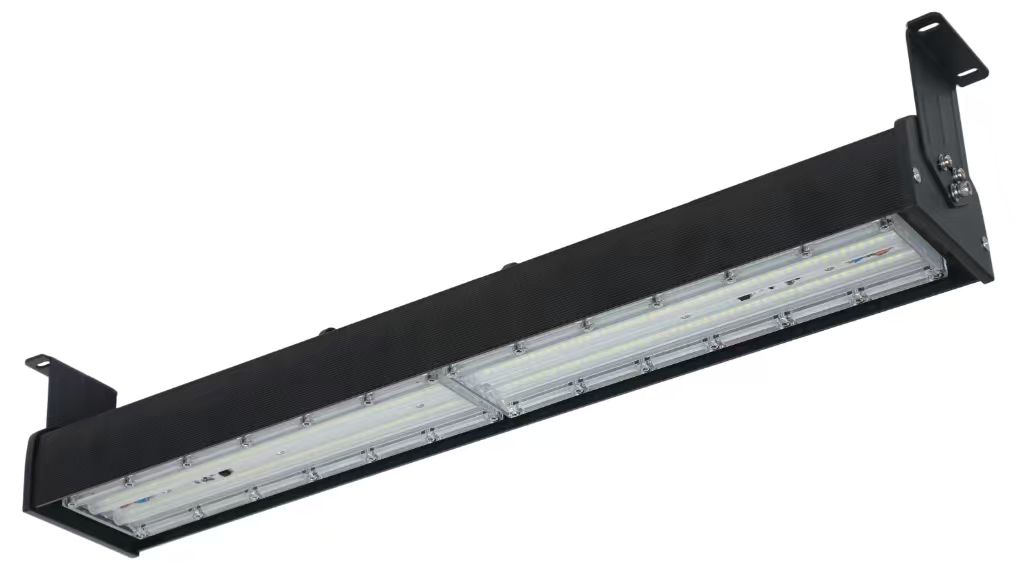
The SH-E01 is a linear high bay built for warehouses, factories and workshops. It uses an aluminum alloy housing with a PC/PMMA lens and is rated IP65 for dust and water protection — the rating most often requested for harsh industrial interiors. Power options are 50 W, 100 W, 150 W and 200 W, with efficacy tiers of 100, 135 and 150 lm/W. The light distribution is stated as 90° horizontally by 120° vertically, described by the manufacturer as a wide beam angle for broad area coverage.
- Body lengths: 305.6×97.3×68.1 mm, 580.6×97.3×68.1 mm and 855.6×97.3×68.1 mm.
- Colour temperature: 3000 K, 4000 K, 5000 K or 6500 K.
- Mounting: mounting kit for surface installation, or chain/cable suspension — two documented options.
- Installation detail: one-piece connector design, with a lightweight and slim linear profile.
- Driver and warranty: a branded driver, backed by a 5-year warranty.
HL-E01: UFO LED high bay, 100–240 W
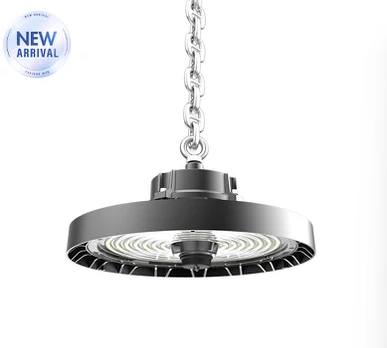
The HL-E01 is a round UFO high bay with a die-cast aluminum body and a PC lens. The housing uses a hollow heat-dissipation structure, and the fixture is positioned for warehouses, factories, retail spaces and gyms — a broader stated application scope than the linear model. Power options are 100 W, 150 W, 200 W and 240 W, with efficacy tiers of 140, 160, 185 and 210 lm/W.
- Input voltage: 185–265 V or 100–265 V.
- Surge protection: 6 KV/6 KV.
- Colour temperature: 4000 K, 5000 K or 6500 K.
- Power supply: Sosen and Moso power supplies, described as premium supplies chosen for stable performance and long lifespan.
- Wiring: pre-wired to the power supply with a 3×1.0 mm² cable and 300 mm exposed leads.
- Sensing: optional motion-sensor compatibility with a smooth 3-second brightness transition.
4. Side-by-side specification comparison
| Specification | SH-E01 LED linear high bay | HL-E01 UFO LED high bay |
|---|---|---|
| Form factor | Linear bar, three body lengths | Round UFO body |
| Power options | 50 / 100 / 150 / 200 W | 100 / 150 / 200 / 240 W |
| Luminous efficacy | 100 / 135 / 150 lm/W | 140 / 160 / 185 / 210 lm/W |
| Beam angle | 90° (H) × 120° (V) | Not listed in the specification set |
| Colour temperature | 3000 K / 4000 K / 5000 K / 6500 K | 4000 K / 5000 K / 6500 K |
| Housing and lens | Aluminum alloy housing + PC/PMMA lens | Die-cast aluminum body + PC lens |
| Ingress protection | IP65 | Not listed in the specification set |
| Surge protection | Not listed in the specification set | 6 KV / 6 KV |
| Input voltage | Not listed in the specification set | 185–265 V / 100–265 V |
| Mounting | Mounting kit for surface installation, or chain/cable suspension | Not listed in the specification set |
| Connection | One-piece connector design | Pre-wired, 3×1.0 mm² cable, 300 mm exposed leads |
| Sensing | Not listed in the specification set | Optional motion sensor, 3-second brightness transition |
| Driver / power supply | Branded driver | Sosen and Moso power supplies |
| Dimensions | 305.6×97.3×68.1 / 580.6×97.3×68.1 / 855.6×97.3×68.1 mm | Not listed in the specification set |
| Warranty | 5 years | Not listed in the specification set |
| Stated application scope | Warehouses, factories, workshops | Warehouses, factories, retail spaces, gyms |
Rows marked “Not listed in the specification set” mean the detail is not part of the published data used for this comparison. They are not negative findings about either fixture; each must be confirmed in writing with the supplier before the specification is frozen.
5. Decision checklist: four criteria that settle the choice
5.1 Ceiling height and layout geometry
Clear height sets the first filter. Where a hall is open and the fixture grid is regular, a round high bay allows the designer to place fewer, higher-output points — the HL-E01 reaches 240 W and efficacy tiers up to 210 lm/W, so a tall open ceiling is served inside a single model family. Where the ceiling follows long racking runs or production lines and the light has to spread laterally across an aisle, the linear format is usually the easier geometry: the SH-E01 distributes on a 90°(H) × 120°(V) beam described as wide, in three body lengths that can follow the run.
Decision rule: a point-based layout on a regular open grid starts with the UFO; a line-based layout along aisles, racks or benches starts with the linear fixture. Either choice should be confirmed by a lighting design rather than a rule of thumb.
5.2 Mounting method and building structure
Mounting is where purchase cost and installation cost separate. The SH-E01 is documented with two options — a mounting kit for surface installation or chain/cable suspension — so the same fixture can be specified against a solid ceiling or an open truss, and the choice can be deferred until the structure is surveyed. Its one-piece connector design also shortens the wiring step in the installation sequence.
The HL-E01 is documented with a pre-wired power supply, a 3×1.0 mm² cable and 300 mm exposed leads, which simplifies the connection point at the fixture. Mounting hardware for the UFO body is not listed in the specification set used here, so the bracket or suspension arrangement must be confirmed before installation drawings are issued.
Decision rule: if the ceiling type is not yet fixed, or a project mixes solid slabs with exposed trusses, the two stated mounting options on the SH-E01 remove a coordination step. If the connection point is the constraint, plan the HL-E01 around its stated lead length and confirm the bracket in writing.
5.3 Ambient conditions: dust, moisture and surge
Two different site risks are addressed by the two data sheets. Dust and water ingress are stated for the SH-E01 at IP65, which supports use in harsh industrial interiors and allows routine cleaning without exposing the light engine. Electrical exposure is stated for the HL-E01 at 6 KV/6 KV surge protection, supported by a die-cast aluminum body with a hollow heat-dissipation structure — relevant where switching loads, nearby equipment or seasonal storms put surges onto the lighting circuit.
Input voltage adds a second environmental consideration. The HL-E01 is offered in 185–265 V and 100–265 V versions; the SH-E01 voltage range is not listed in the specification set used here and must be confirmed against the site supply before order.
Decision rule: dust and wash-down exposure point to the IP65 linear fixture; known surge exposure points to the 6 KV-rated UFO. Neither rating should be assumed for the other model in this pair.
5.4 Maintenance expectations
Maintenance is a five-year cost, not a purchase-order line. Three documented facts decide how the two fixtures compare. Warranty: the SH-E01 carries a 5-year warranty, while a warranty term for the HL-E01 is not listed in the specification set used here. Driver sourcing: the SH-E01 uses a branded driver, the HL-E01 uses Sosen and Moso power supplies, and named supply brands are easier to cross-reference when spare strategy is planned. Access and connection: the SH-E01's one-piece connector simplifies replacement at height, and the HL-E01's pre-wired leads shorten the initial connection but must be planned for at the point of service.
Decision rule: where access equipment is expensive or production shutdowns are costly, weight warranty length and connector design heavily. Where energy management needs occupancy control, the HL-E01's optional motion sensor with a 3-second brightness transition avoids adding a separate control layer.
6. Step-by-step: specifying a high-bay package for a warehouse or factory
- Fix the room data first. Record clear height, truss or slab type, aisle and racking layout, dust and moisture conditions, and the site supply voltage. These five inputs eliminate one format in most projects.
- Set the power and efficacy band. Choose from 50–200 W on the SH-E01 or 100–240 W on the HL-E01, then select the efficacy tier. Where the design load is below 100 W per point, only the linear model covers it; where it exceeds 200 W, only the UFO covers it.
- Select beam and colour temperature. The SH-E01 offers a 90°(H) × 120°(V) beam and four CCT options from 3000 K to 6500 K; the HL-E01 offers three CCT options from 4000 K to 6500 K. Map CCT to the task: higher CCT for inspection and picking areas, warmer CCT where visual comfort is the priority.
- Match mounting to structure. Confirm whether surface mounting or suspension is required, and confirm bracket or hardware in writing for the model finally chosen.
- Match protection to the environment. Record ingress requirement and surge requirement separately, then confirm which model satisfies both. In this pair, IP65 and 6 KV protection are stated for different models.
- Close the loop on documentation and delivery. Obtain the data sheet, the compliance documentation required for the destination market, the warranty statement, the MOQ and the lead time before releasing the purchase order.
7. Where each fixture fits: project use cases
| Project situation | SH-E01 linear high bay | HL-E01 UFO high bay |
|---|---|---|
| Warehouse with long racking aisles | Linear body follows the aisle run; 90°(H) × 120°(V) beam spreads coverage across the aisle | Workable alternative where the grid is open and a point layout is preferred |
| Factory production hall | IP65 body for dusty or wash-down interiors; surface or suspended mounting | Higher power ceiling (up to 240 W) and efficacy tiers up to 210 lm/W for tall open bays |
| Workshop with service-access constraints | Lightweight profile, one-piece connector, 5-year warranty | Pre-wired leads simplify the connection point during installation |
| Retail space or gym in a mixed-use building | Rated for warehouses, factories and workshops; confirm before extending use | Stated application scope includes retail spaces and gyms |
| Site with known electrical surge exposure | Confirm surge protection in writing | 6 KV/6 KV surge protection stated |
| Energy management via occupancy control | Confirm control options in writing | Optional motion-sensor compatibility with 3-second brightness transition |
Both fixtures sit inside a product range that also covers LED floodlights, street lights, garden lights, stadium lights, solar flood, solar street and solar garden lights, bulkheads, tri-proof lights, work lights, ceiling lights, panel lights, battens, tubes and bulbs — which matters when a single project spans interior halls and exterior areas.
8. What this comparison does not cover
- Photometric layout. Spacing, uniformity and layout results are not part of the data used here; a lighting design is still required before quantities are fixed.
- Dimming protocols. An optional motion sensor is listed for the HL-E01; a dimming protocol is not listed for either model.
- Lifetime and lumen-maintenance figures. Not listed for either model in the specification set used here.
- Price. Neither model carries a public list price; both must be quoted on the same configuration basis.
- Market-specific certification. The manufacturer states that it holds industry certifications and qualification certificates; the exact certificate required by the destination market must be confirmed per project.
9. Ordering, customization and lead time
Zhejiang Lepeng Electric Appliance Co.,Ltd. was founded in 2009 and manufactures LED lamps and luminaires with 200,000 m² of factory space, 2,000 employees and a monthly capacity of 45 million LED lamps and 5 million LED luminaires, across production sites in Zhejiang and Jiangxi. Around 90% of output is exported, with the EU, Southeast Asia, the Middle East and Latin America as main markets.
Production lead time is 30–45 days, and MOQ depends on the product. OEM/ODM projects are supported, including customization of fixture appearance, power and accessories, agreed through product communication. For a warehouse or factory project, send the room data, the required wattage and CCT, the mounting method and the destination market, so both fixtures are quoted on the same basis.
10. FAQ
Which standards and protection ratings should be verified before a high bay is approved for a warehouse?
UL Solutions lists IEC 60598, UL 1598 and UL 8750 among the core standards applied to luminaires and LED equipment. On the data sheet itself, confirm the ingress protection figure — the SH-E01 linear high bay is rated IP65 for dust and water protection — and confirm surge protection separately where the site has known electrical exposure; the HL-E01 is rated 6 KV/6 KV. Also confirm which certificates the destination market requires before the specification is released.
Which format suits a high-ceiling warehouse — linear or UFO?
Both are positioned for warehouse and factory use, so the decision comes from layout. The HL-E01 extends to 240 W with efficacy tiers up to 210 lm/W, which suits tall open spaces served by concentrated, point-based fixtures. The SH-E01 covers 50–200 W with a 90°(H) × 120°(V) beam described as wide, plus two mounting options, which suits racking- or aisle-based layouts where coverage has to spread along a run. Confirm the layout with a lighting design before ordering.
What drives the cost difference between the SH-E01 and the HL-E01?
Neither model carries a public list price, so the comparison has to be built from configuration. The cost drivers in this pair are the power and efficacy tier selected, the driver or power supply (a branded driver on the SH-E01; Sosen and Moso power supplies on the HL-E01), the housing construction (aluminum alloy with PC/PMMA lens versus die-cast aluminum with PC lens), the surge protection requirement, and warranty length — the SH-E01 carries a 5-year warranty. Request a quotation with wattage, CCT, beam and mounting method specified so both options are priced on the same basis.
Can a sample be validated before a project order is placed?
Yes — samples can be requested to check form factor, mounting hardware and light distribution against the site before a volume commitment. MOQ depends on the product, and OEM/ODM customization of appearance, power and accessories is agreed through product communication, so the sample should be specified with the final wattage, CCT and mounting method rather than as a generic unit.
What is the lead time, and can other fixture types for the same project be ordered together?
Production lead time is 30–45 days, and MOQ depends on the product. The range covers floodlights, high bays, linear high bays, street lights, garden lights, stadium lights, solar flood, street and garden lights, bulkheads, tri-proof lights, work lights, ceiling lights, panel lights, battens, tubes and bulbs, so indoor and outdoor fixture types can be ordered as one project package. For construction-site and outdoor areas — where a high bay is not the appropriate fixture type — the FL-C01 floodlight series covers 10–300 W with efficiency of 100/120 lm/W, power factor above 0.9 and surge protection up to 2 KV. Send the project schedule with your datasheet request to fish@idealbright.com or via WhatsApp.
11. Conclusion
The choice between the SH-E01 and the HL-E01 is not a verdict on which high bay is better. It is a mapping exercise. On one side: IP65 protection, a 5-year warranty, an aluminum alloy housing with PC/PMMA lens, 50–200 W, a 90°(H) × 120°(V) beam and two mounting options for warehouses, factories and workshops. On the other: 100–240 W, efficacy tiers up to 210 lm/W, 6 KV/6 KV surge protection, Sosen and Moso power supplies, optional motion-sensor compatibility and a die-cast aluminum body positioned for warehouses, factories, retail spaces and gyms. Fix the ceiling height, the mounting method, the ambient conditions and the maintenance plan in that order, and the format usually selects itself before price is discussed.
Next step: request the datasheet, sample or project quotation
Zhejiang Lepeng Electric Appliance Co.,Ltd. — No. 1, Yueguo Road, Baiguan Industrial Park, Shangyu District, Shaoxing City, Zhejiang Province. Tel: +86-575-82188752 · Email: fish@idealbright.com · Website: www.idealbright.com
Download the full catalogue and specification sheets: Commercial LED Lighting Brochure (PDF). When you send an inquiry, include room height, mounting type, required wattage and CCT, and the destination market so the SH-E01 and HL-E01 can be quoted side by side.
Have Questions or Need More Details?
Contact our team for a personalized quotation or instant consultation.
Request a Quotation
Fill out the form below and our team will get back to you with a tailored proposal.
WhatsApp Direct Chat
Prefer to chat in real-time? Message us on WhatsApp for instant assistance & quick answers.
- Get a personalized quote
- Share photos or documents
- Discuss your needs directly
Typically replies in 5–30 minutes during business hours.