Commercial LED Linear High Bay Parameters for Warehouses: SH-E01 Reference
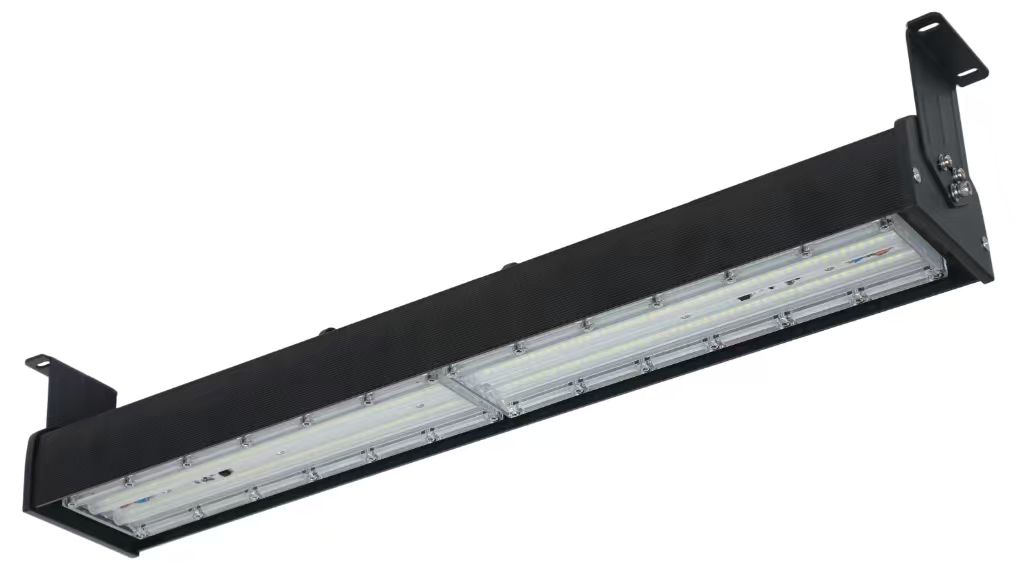
Specifying commercial LED lighting for a warehouse comes down to five parameter groups: power rating, luminous-efficacy tier, beam angle, correlated colour temperature (CCT), and the housing/ingress combination. On the SH-E01 commercial LED linear high bay light, those groups resolve to 50 / 100 / 150 / 200 W, 100 / 135 / 150 lm/W, a 90° (H) × 120° (V) beam, 3000K / 4000K / 5000K / 6500K, and an IP65 aluminum alloy housing with a PC/PMMA lens, supported by a 5-year warranty. This technical guide explains what each value constrains on a warehouse floor, how the values interact, and how to write them into a project schedule so the installed result matches the design intent.
Problem Definition: Where Linear High Bay Specifications Break Down
Most warehouse lighting disappointments are specification failures rather than product failures. A fixture can be manufactured to a consistent standard and still be the wrong fixture for the building it is installed in — because the wattage matched the budget, but the beam did not match the aisle, the ingress class did not match the dust load, or the driver was never specified at all.
Four patterns account for most of the re-specification work:
- Buying on wattage alone. A 150 W rating is not a light output. At 150 W, a fixture rated 100 lm/W delivers 15,000 lm, while the same rating at 150 lm/W delivers 22,500 lm — a 50% difference in delivered flux from an identical nameplate. Layouts built on wattage alone routinely end up either dim or over-lit.
- Beam shape treated as an afterthought. A circular distribution throws a bright pool and leaves the ends of an aisle row dark. A linear fixture distributes asymmetrically because its job is to run along the rack line: the SH-E01 uses 90° in the horizontal plane and 120° in the vertical plane for exactly that reason.
- Ingress class ignored. A body without adequate sealing in a dusty or washdown-adjacent hall collects dust on the optic, and lens cleaning becomes a standing maintenance task instead of an occasional one.
- Mounting and connection left open. When the schedule does not fix surface kit versus suspension, installers improvise, row spacing drifts, and the lighting layout silently changes between drawing and handover.
The practical consequence is not a warranty claim in most cases — it is a second purchase. The question a buyer should be answering is therefore not “which fixture is best”, but “which combination of parameters matches this building, this task and this maintenance regime”.
Industry Background: Why Parameter Literacy Filters the Market
Commercial lighting is a large, LED-dominant category. Grand View Research estimated the global commercial lighting market at USD 47.54 billion in 2024, with LED products holding a 58.1% revenue share in that year. Fortune Business Insights valued the wider global LED lighting market at USD 109.11 billion in 2025 and projected USD 336.90 billion by 2034. On the supply side, the Observatory of Economic Complexity recorded China exporting USD 31.4 billion in light fixtures in 2024, equal to 59.3% of total global light fixture exports.
For a warehouse project, those figures describe a deep and heavily export-oriented supply base. Depth is useful for price competition, but it also means proposals arrive in wildly different formats: one supplier sends a wattage list and a price, another sends a full photometric file. The buyer's filter is parameter literacy — the ability to ask for efficacy, beam geometry, ingress class, driver specification and warranty terms in the same document.
Two layers of documentation sit behind those parameters. The first is the safety and performance standard: IEC 60598 for luminaires internationally, UL 1598 for luminaires and UL 8750 for LED equipment in the United States, as listed by UL Solutions. The second is the certificate issued against those standards for a specific model in a specific market. Standards tell the buyer what a compliant fixture must satisfy; certificates tell the buyer whether this fixture, in this shipment, satisfies it.
Detailed Solution: The SH-E01 Parameter Set and What Each Value Controls
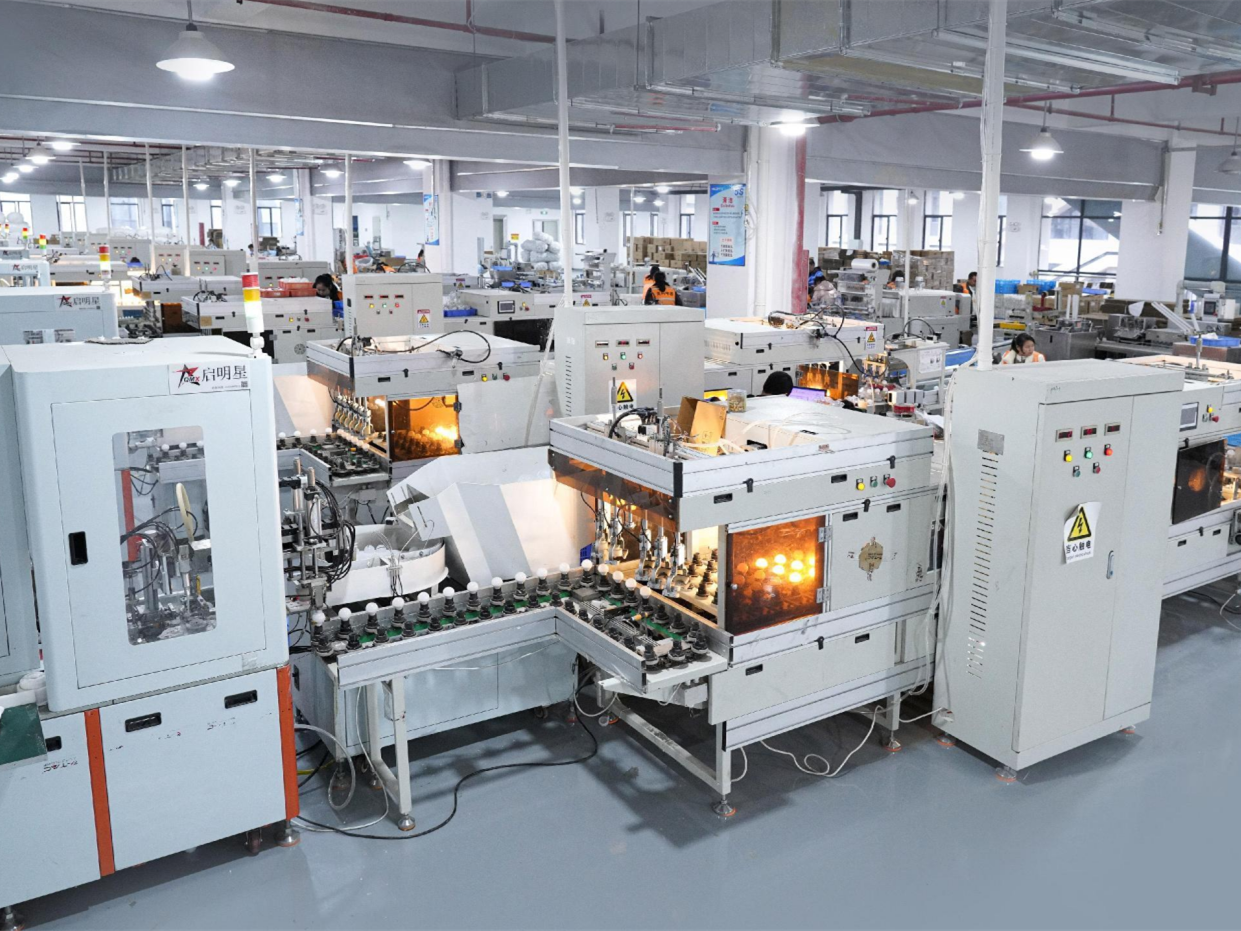
The SH-E01 is a commercial LED linear high bay light from Zhejiang Lepeng Electric Appliance Co.,Ltd., a Chinese LED lighting manufacturer founded in 2009 and headquartered in the Baiguan Industrial Zone of Shangyu, Zhejiang Province. Lepeng operates three production bases — Shangyu and Qiandaohu in Zhejiang, and Jingdezhen in Jiangxi — employs 2,000 workers, and sells under its MKOPTO brand, with 90% of output exported to the EU, Southeast Asia, the Middle East and Latin America.
The table below maps the published SH-E01 specification to the decision it constrains. It is the single most useful page to bring to a supplier meeting, because every value in the middle column can be checked against a certificate, a datasheet or a delivered sample.
| Parameter | SH-E01 specification | What it constrains in a warehouse |
|---|---|---|
| Power | 50 / 100 / 150 / 200 W | Fixture count per layout and connected load per circuit |
| Luminous efficacy | 100 / 135 / 150 lm/W | Delivered lumens per watt and operating energy per hour |
| Beam angle | 90° (H) × 120° (V) | Coverage along the aisle versus spill across the racking face |
| CCT | 3000K / 4000K / 5000K / 6500K | Task contrast, perceived brightness and zone consistency |
| Dimensions | 305.6×97.3×68.1 mm / 580.6×97.3×68.1 mm / 855.6×97.3×68.1 mm | Fitting between trusses, services and racking; row length |
| Protection | IP65 | Dust-tight construction and resistance to water jets; cleaning method |
| Housing and lens | Aluminum alloy housing + PC/PMMA lens | Heat path from the LED module; sealed optical chamber |
| Warranty | 5 years | Maintenance budget, spares planning and claim exposure |
| Mounting | Mounting kit surface installation or chain/cable suspension | Ceiling interface and install sequence |
| Connection | One-piece connector | Per-fixture wiring time across a long row |
Power ratings: 50, 100, 150 and 200 W
The four ratings cover two different layout strategies. Lower ratings in a denser grid improve uniformity and reduce glare at the fixture; higher ratings in a wider grid reduce mounting points, cable runs and installation labour. Neither is automatically correct. What matters is that the chosen grid is checked against truss spacing and rack line length, because a 200 W fixture that cannot be physically placed on the structural grid is a specification error no datasheet will reveal.
Luminous efficacy: the tier decides energy before wattage does
The three efficacy tiers — 100, 135 and 150 lm/W — are the most commercially important values in the table, because they let the buyer trade first cost against running energy and fixture count. Section below converts the tiers into nominal flux per rating so the trade-off can be calculated rather than argued.
Beam angle: 90° horizontal by 120° vertical
The asymmetric emission is the defining property of a linear high bay. The 120° vertical spread runs along the axis of the fixture and covers the gap between mounting positions in a row; the 90° horizontal spread limits how far light spills sideways across the aisle. The installation consequence is simple but frequently missed: the long axis of the fixture must be parallel to the aisle, otherwise the two planes swap and the aisle is lit across its width instead of along its length. Write the orientation into the installation drawing, not just the datasheet.
CCT: 3000K, 4000K, 5000K and 6500K
Four colour temperatures allow zone-by-zone assignment within one building rather than a single compromise value. Warm 3000K reads better in low-level circulation and dispatch areas; 4000K is a neutral general-warehouse value; 5000K suits inspection, packing and assembly tasks where contrast matters; 6500K gives a cool, high-contrast appearance for large-volume distribution halls. Keep one CCT per continuous space — mixing values inside a single sight line is visible as patchiness long before any light meter shows a problem.
Ingress protection and materials: IP65 in an aluminum alloy body
IP65 denotes dust-tight construction plus protection against water jets. In practice, that is the threshold that separates a fixture you clean with a pressure washer or an air line from one you clean with a cloth. The housing material matters for a different reason: the aluminum alloy body carries heat away from the LED module, and the PC/PMMA lens closes the optical chamber so dust and moisture reach the lens surface rather than the LEDs and driver. Lepeng positions the SH-E01 for harsh industrial environments on the strength of that combination.
Driver, warranty and the maintenance plan
The SH-E01 carries a 5-year warranty and uses a high-quality branded driver. For a warehouse operator, the warranty period is really a maintenance planning horizon: it defines how long driver replacement should be a supplier cost rather than an operating cost. Buyers should ask what the warranty covers, who performs the replacement, and whether the driver is available as a spare part for the full period — the answer determines whether a 5-year warranty is a budget protection or a document.
Dimensions, mounting and connection
Three body lengths — 305.6 mm, 580.6 mm and 855.6 mm, all 97.3 mm wide and 68.1 mm deep — let a row be built to the length of the racking run rather than to a fixed module. Two mounting methods are offered: a mounting kit for surface installation where the structure allows direct fixing, and chain or cable suspension where services run below the roof. The one-piece connector addresses installation labour directly, since a long row means dozens of terminations and per-fixture time savings compound.
Calculated Lumen Output by Power and Efficacy Tier
The table below multiplies each rated power by each rated efficacy tier to give nominal luminous flux. This is arithmetic on published values, not a measured or tested lumen figure, and it is the calculation a buyer should run before accepting a fixture count.
| Rated power | at 100 lm/W | at 135 lm/W | at 150 lm/W |
|---|---|---|---|
| 50 W | 5,000 lm | 6,750 lm | 7,500 lm |
| 100 W | 10,000 lm | 13,500 lm | 15,000 lm |
| 150 W | 15,000 lm | 20,250 lm | 22,500 lm |
| 200 W | 20,000 lm | 27,000 lm | 30,000 lm |
Reading the table: moving a 200 W row from the 100 lm/W tier to the 150 lm/W tier raises nominal output from 20,000 lm to 30,000 lm per fixture — enough, in many layouts, to reduce the fixture count. The correct tier depends on run hours, electricity cost and the number of mounting points the building can support, not on the datasheet alone.
Step-by-Step: Writing the Specification for a Warehouse Project
The sequence below keeps the parameters in dependency order. Changing any earlier step invalidates later ones, which is why the order matters more than the individual values.
- Record the space before choosing a product. Capture mounting height, aisle width, rack height, truss positions, overhead services, dust and moisture conditions, and operating hours. The output is a mounting-height band and an obstruction map, not a product code.
- Fix the light level per zone. Take the maintained illuminance requirement for aisle floors, rack faces and inspection benches from the project's lighting design or the client's standard, and write the values into the schedule. Without a target, no parameter choice can be evaluated.
- Choose the efficacy tier before the wattage. The 150 lm/W tier reduces fixture count and operating energy; the 100 lm/W tier is where first cost dominates. Decide which constraint governs the project, then hold that choice across the whole building.
- Size the power rating from the required lumens. Divide the zone's lumen requirement by the chosen efficacy tier, then select from 50 / 100 / 150 / 200 W and check the resulting fixture count against the physical grid from step 1.
- Set CCT by zone. Assign 3000K, 4000K, 5000K or 6500K per area in the schedule and keep one value per continuous space. This is a project decision, not a preference to be settled on site.
- Lock the beam orientation. State on the drawing that the fixture's long axis runs parallel to the aisle, so the 120° plane falls along the row and the 90° plane across it. Orientation errors are invisible on a datasheet and obvious in the hall.
- Specify mounting method and connection. Choose the mounting kit for surface installation or chain/cable suspension for each area, and require the one-piece connector to keep per-fixture wiring time down. Confirm the connected load per circuit for the chosen row.
- Attach documentation and commercial terms. Require the certificate number, issuing body, applicable standard and the model named on the certificate, together with the warranty length and the spares route. Lepeng quotes a production lead time of 30–45 days, so schedule the first delivery against that window rather than against a catalogue promise.
Use Cases: Where the Linear Format Earns Its Place
High-rack distribution centres
Long racking runs reward the linear format. A row of SH-E01 fixtures mounted parallel to the aisle puts the 120° plane along the run, so the gap between mounting positions stays lit and the number of suspension points falls. The 855.6 mm body gives a longer module for long runs; the 305.6 mm body suits short or interrupted runs where a long fixture will not fit between structural members.
Manufacturing and assembly bays
Assembly areas usually need higher contrast than storage areas, which points to 5000K and a mid-range 150 W rating with a mounting kit surface installation where the roof structure allows direct fixing. IP65 also pays off here, because airborne process dust settles on every upward-facing surface in the hall.
Dusty and washdown-adjacent workshops
In woodworking, ceramics or packaging outer zones, the fixture is exposed to dust that a sealed optic simply sheds. IP65 combined with the aluminum alloy housing and PC/PMMA lens keeps contamination at the lens surface, where it can be removed during routine cleaning instead of accumulating inside the optical chamber.
Retrofits of existing linear rows
Where old linear fluorescent rows already define the layout, chain or cable suspension can reuse the existing suspension points, and the three body lengths allow the new row to follow the old one. The one-piece connector shortens the electrical work per fixture, which is where retrofit labour cost usually concentrates.
Comparison: SH-E01 Linear High Bay vs HL-E01 UFO High Bay
Lepeng also manufactures the HL-E01, a UFO-format LED high bay light. The two formats solve different problems, and the comparison below uses only published model data; where a value is not stated for a model, the cell says so rather than filling the gap.
| Criterion | SH-E01 (linear) | HL-E01 (UFO) |
|---|---|---|
| Form factor | Linear body, three lengths | Die-cast aluminum round body with hollow heat dissipation structure |
| Power range | 50 / 100 / 150 / 200 W | 100 / 150 / 200 / 240 W |
| Luminous efficacy | 100 / 135 / 150 lm/W | 140 / 160 / 185 / 210 lm/W |
| Beam angle | 90° (H) × 120° (V) | Not stated in the model data |
| CCT options | 3000K / 4000K / 5000K / 6500K | 4000K / 5000K / 6500K |
| Housing and lens | Aluminum alloy housing + PC/PMMA lens | Die-cast aluminum body + PC lens |
| Ingress protection | IP65 | Not stated in the model data |
| Warranty | 5 years | Not stated in the model data |
| Electrical detail | Not stated in the model data | 6KV surge protection; 185-265V or 100-265V input; 3×1.0mm² cable with 300 mm exposed leads, pre-wired |
| Typical fit | Aisle lighting along racking runs, low-clearance structures, linear retrofits | Point-source lighting where higher efficacy per fixture is the priority |
The honest reading is that the HL-E01 publishes a higher efficacy ceiling, while the SH-E01 publishes a defined beam geometry, an IP65 rating and a 5-year warranty — three values that matter specifically when the installation is dusty, the aisles are linear and the maintenance plan depends on a warranty horizon. Neither format is universally superior; the aisle geometry and the contamination load decide.
Compliance and Documentation: What to Verify Before Release
For a warehouse project, the documentation check is short but must be literal. Luminaire safety is assessed against IEC 60598 internationally; in the US market, UL 1598 covers luminaires and UL 8750 covers LED equipment. On top of the standard, the buyer should see the certificate issued for the specific model and market.
For the SH-E01, the certificate record links the model to a TUV SUD GS certificate numbered Z1A 123276 0002 Rev. 00, issued 23 January 2024 for the EU market under CE-LVD and GS, citing EN 60598-1:2021+A11:2022, EN 60598-2-1:2021, EN 62493:2015 and AFPS GS 2019:01 PAK. Lepeng's EU documentation set also includes a CE-EMC attestation numbered E8A 123276 0630 Rev. 00, issued by TUV SUD under EMC Directive 2014/30/EU — recorded against the PL02 LED panel light rather than the SH-E01, which is exactly why the model named on a certificate has to be checked rather than assumed.
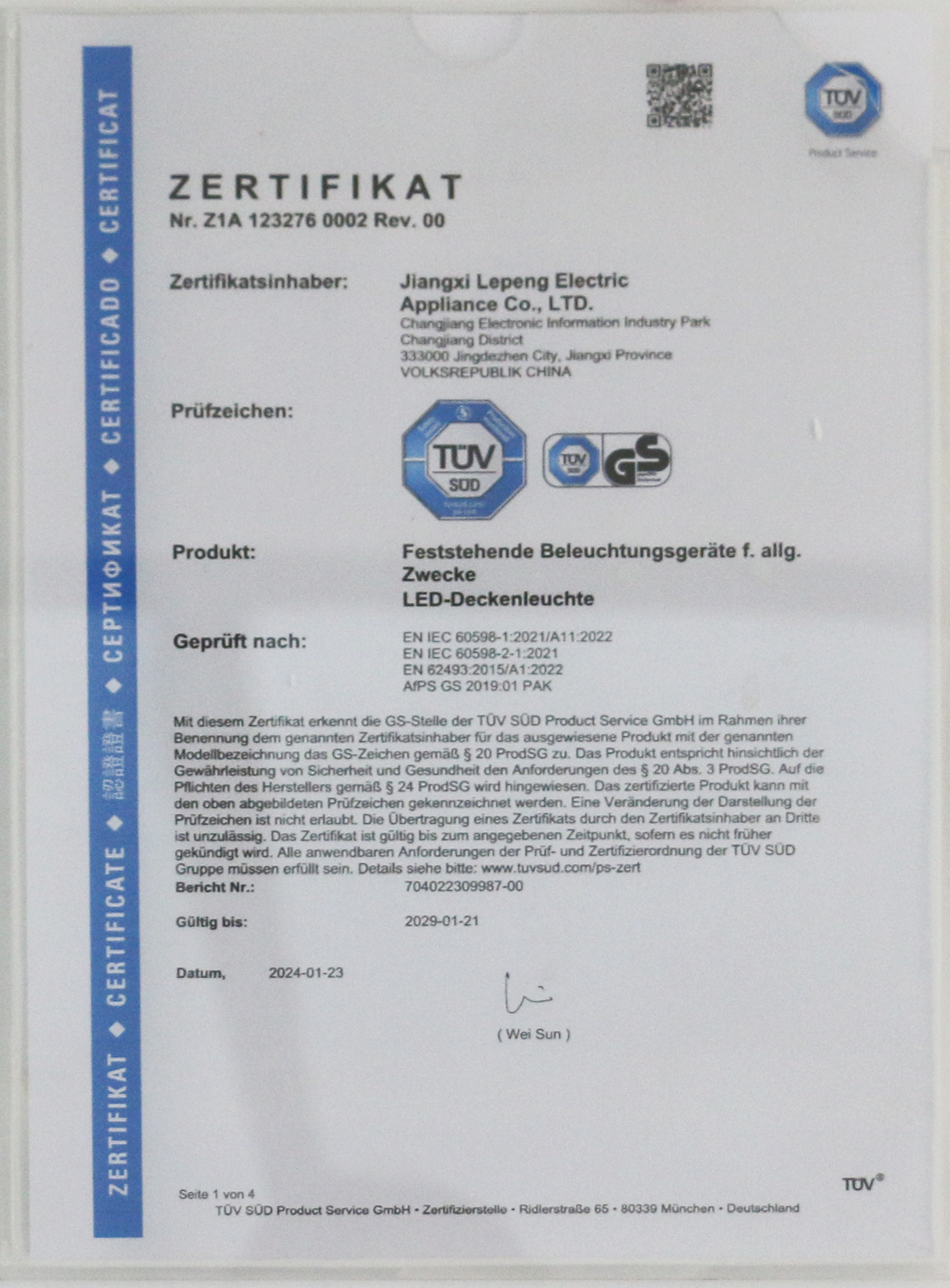
Four questions close the compliance loop on any linear high bay quotation:
- What is the certificate number, and which body issued it?
- Which standard or standards does the certificate cite?
- Which model designation appears on the certificate itself?
- Which market or region does the certificate cover?
Manufacturing context supports the same check from the other direction. Lepeng reports a factory footprint of 200,000 m², a workforce of 2,000, an R&D team of 200, annual output of 540 million lamps, and monthly capacity of 45 million LED lamps and 5 million LED luminaires — capacity figures that matter to a distributor planning a multi-phase warehouse rollout rather than a single hall, and that sit behind Lepeng's quoted 30–45 day lead time.
The Wider Commercial LED Lighting Range and Project Support
The SH-E01 is one model inside a broader commercial LED lighting range that also includes the commercial LED flood light, commercial LED street light, commercial LED high bay light in UFO format, commercial LED tri-proof light, commercial LED work light, commercial LED bulkhead light, commercial LED panel light, commercial LED tube light, commercial LED slim batten light, commercial LED ceiling light, commercial LED garden light, commercial LED stadium light, commercial LED bulb and commercial LED ceiling fan light, plus solar LED flood light, solar LED street light and solar LED garden light ranges. For a distributor or contractor, that breadth matters less for its own sake than for consolidation: fewer suppliers, one documentation set, one lead time.
Lepeng supports OEM and ODM customisation covering fixture appearance, power and accessories, with scope confirmed during product communication, and MOQ depending on the product. For buyers evaluating a warehouse rollout, the useful starting point is a sample in the exact configuration under consideration — wattage, CCT, body length and mounting method — so the evaluation tests the specification rather than a generic unit.
FAQ
Which certifications should a warehouse linear high bay carry for EU or US projects?
Luminaire safety is normally assessed against IEC 60598 internationally; in the US market, UL 1598 covers luminaires and UL 8750 covers LED equipment, as listed by UL Solutions. For EU projects, the SH-E01 is listed among the related products on a TUV SUD GS certificate (Z1A 123276 0002 Rev. 00) that cites EN 60598-1:2021+A11:2022, EN 60598-2-1:2021, EN 62493:2015 and AFPS GS 2019:01 PAK. Always ask for the certificate number, issuing body, standard and the exact model named on the document.
Can the SH-E01 be configured to a project's power, CCT and length?
The model is offered at 50 / 100 / 150 / 200 W, in efficacy tiers of 100 / 135 / 150 lm/W, with 3000K / 4000K / 5000K / 6500K options and three body lengths of 305.6 mm, 580.6 mm and 855.6 mm. Beyond selecting from these published options, Lepeng supports OEM and ODM customisation of fixture appearance, power and accessories, with the exact scope confirmed during product communication and MOQ depending on the product.
What drives the cost per fixture in a warehouse linear high bay order?
Four levers dominate: the efficacy tier selected (100, 135 or 150 lm/W), the driver specification behind the 5-year warranty, the power rating and body length combination, and the housing and ingress specification. Order quantity and the MOQ position for the specific configuration then set the commercial frame. Because these variables interact, a per-fixture figure without the layout, wattage, CCT and mounting method attached is not comparable across suppliers.
Can I evaluate a sample before committing to a volume order?
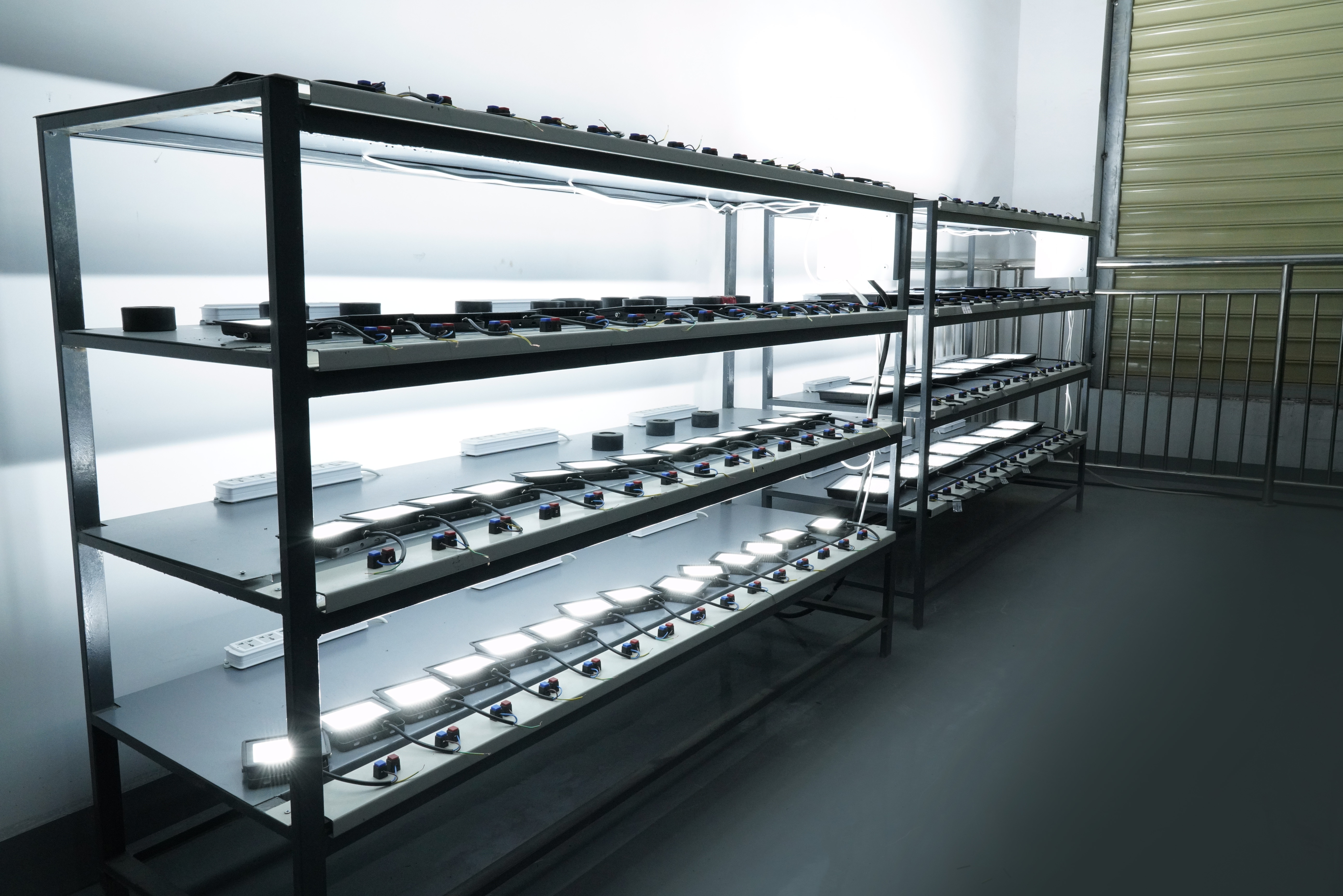
Yes. Sample evaluation is the practical way to test beam orientation, light distribution along an aisle and lens behaviour under local cleaning practice before a rollout. Specify the wattage, CCT, body length and mounting method when requesting the sample, so the unit matches the intended specification rather than a default configuration; Lepeng handles sample requests through its direct sales contact.
What lead time should a warehouse project plan for?
Lepeng quotes a production lead time of 30–45 days, supported by monthly capacity of 45 million LED lamps and 5 million LED luminaires across its production bases. Plan the first delivery against that window and order spares in the same shipment, since the 5-year warranty horizon is easier to manage when a small stock of matching units is held on site. For a specification review, a quotation or a sample request on the SH-E01, contact the Lepeng team directly at fish@idealbright.com or +86-575-82188752, or download the product catalogue below.
Conclusion
A warehouse linear high bay is specified correctly when five parameter groups are written down and checked against the building: power rating, efficacy tier, beam geometry, CCT, and housing with ingress class. On the SH-E01 those values are 50 / 100 / 150 / 200 W, 100 / 135 / 150 lm/W, 90° (H) × 120° (V), 3000K through 6500K, and an IP65 aluminum alloy body with a PC/PMMA lens, with three body lengths, two mounting methods, a one-piece connector and a 5-year warranty.
The discipline that separates a working installation from a re-specification is sequence: measure the space, fix the light level, choose the efficacy tier, then the wattage, then CCT and beam orientation, then mounting and documentation. Buyers who hold that order — and who ask for the certificate number, the standard and the model named on the document — get a lighting scheme that can be verified at handover rather than argued about afterwards.
Next step: sample, quotation or catalogue
Request an SH-E01 sample in your target wattage, CCT, body length and mounting configuration, or ask for a quotation against your warehouse layout.
Download the catalogue: Lepeng commercial LED lighting catalogue (PDF)
Zhejiang Lepeng Electric Appliance Co.,Ltd. — No. 1, Yueguo Road, Baiguan Industrial Park, Shangyu District, Shaoxing City, Zhejiang Province | Tel: +86-575-82188752 | WhatsApp: +86-13777885334 | Email: fish@idealbright.com | www.idealbright.com
Have Questions or Need More Details?
Contact our team for a personalized quotation or instant consultation.
Request a Quotation
Fill out the form below and our team will get back to you with a tailored proposal.
WhatsApp Direct Chat
Prefer to chat in real-time? Message us on WhatsApp for instant assistance & quick answers.
- Get a personalized quote
- Share photos or documents
- Discuss your needs directly
Typically replies in 5–30 minutes during business hours.