How to Select LED High Bay Wattage and Beam Angle for Warehouses
How to Select LED High Bay Wattage and Beam Angle for Warehouses
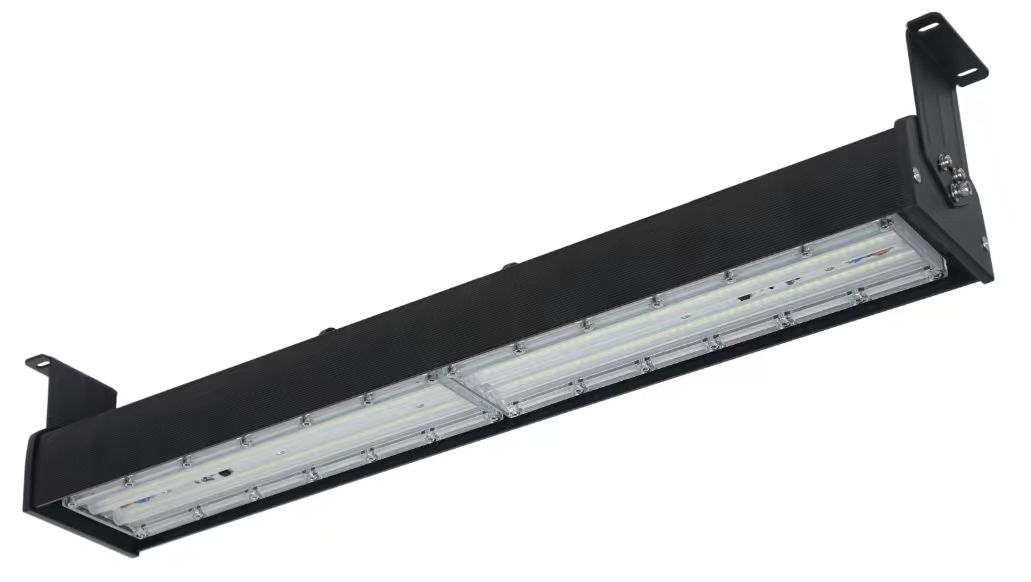
Warehouse lighting projects rarely fail because the wrong technology was chosen. They fail because wattage and beam angle were treated as one decision instead of two. Wattage determines how much light a luminaire can deliver; beam angle determines where that light lands. Two 200W high bays with different distributions can produce completely different working conditions at exactly the same energy cost.
The practical sequence is: set the illuminance target from the task, measure the real mounting height and racking geometry, convert the target into a lumen requirement, then choose the platform and distribution that delivers those lumens evenly. Protection rating, voltage window and surge protection are confirmed afterwards, not first. Zhejiang Lepeng Electric Appliance Co.,Ltd., which manufactures under the MKOPTO brand, covers most of this decision space with two platforms: the linear high bay SH-E01 at 50W-200W and the UFO high bay HL-E01 at 100W-240W. This guide shows how to use both.
Problem Definition: Why Wattage and Beam Angle Are Separate Decisions
Beam angle does not change lumen output. It changes lumen concentration. A narrow distribution pushes the same lumens into a smaller footprint, raising intensity directly beneath the fixture and reducing it everywhere else. A wide distribution spreads the same lumens across a larger area at lower intensity. Because of this, wattage cannot compensate for a distribution that does not match the room.
Three errors appear repeatedly in warehouse specifications:
- Upgrading wattage to fix a distribution problem. Dark rack faces and bright floor pools usually mean light is aimed at the wrong plane, not that output is insufficient. Adding watts raises energy consumption and glare without fixing coverage.
- Assuming efficacy is constant across a product family. Published efficacy figures often vary by wattage within the same series. Lepeng's SH-E01 linear high bay is rated at 100, 135 and 150 lm/W, while the HL-E01 UFO high bay is rated at 140, 160, 185 and 210 lm/W. The figure that matters is the one attached to the wattage you actually order.
- Specifying by ceiling height alone. Two warehouses with identical clear height can need different distributions if one uses high racking and narrow aisles and the other is open floor.
The consequence of getting this wrong is not only visual. Fixture count, circuit loading, maintenance access and the number of spare units held in stock all follow from the wattage and distribution decision, and reversing it later is expensive.
Industry Background: A Very Large Supply Base, A Small Number of Real Variables
Commercial lighting has moved decisively to LED. Grand View Research estimated the global commercial lighting market at USD 47.54 billion in 2024, with LED products holding a 58.1% revenue share. Supply is heavily concentrated in China: the Observatory of Economic Complexity reports that China exported USD 31.4 billion in light fixtures in 2024, equal to 59.3% of global exports in that category.
For a buyer, the practical consequence is that availability is not the constraint; comparability is. A warehouse project can receive quotations from many suppliers using the same vocabulary with different meanings behind it. The standards that anchor comparison are stable and public: IEC 60598 for luminaires, and UL 1598 and UL 8750 for luminaires and LED equipment, as published by UL Solutions. In the EU, the equivalent framework is built on the EN 60598 series.
Lepeng's manufacturing base sits inside this landscape. The company was founded in 2009, operates a 200,000 m2 footprint with 2,000 employees including a 200-person R&D team, and runs production across its Shangyu headquarters plus bases in Qiandaohu (Zhejiang) and Jingdezhen (Jiangxi). Monthly capacity is stated at 45 million LED lamps and 5 million LED luminaires. Around 90% of output is exported, with the EU, Southeast Asia, the Middle East and Latin America as main markets. The HL-E01 and SH-E01 high bay platforms referenced throughout this guide belong to that range, and the company's lighting products serve contractors, distributors, commercial and municipal buyers across global markets.
Detailed Solution: The Specifications That Actually Drive the Result
1. Wattage: define the lumen budget before the number on the label
Wattage is a proxy for output, not output itself. Start from the illuminance the space requires, set by the project's lighting design, the task performed or local workplace lighting rules, then work back to lumens. Only at that point does wattage become meaningful, because wattage is what you multiply by efficacy to reach the lumens you are paying for.
Across the two Lepeng warehouse platforms the usable range is 50W to 240W. SH-E01 is offered at 50W, 100W, 150W and 200W, and HL-E01 at 100W, 150W, 200W and 240W. The overlap is useful rather than confusing: a mid-height bay can be served by either platform, so the selection can be made on distribution and mounting geometry instead of being forced by wattage availability.
2. Luminous efficacy: read the value at the wattage you order
Efficacy, measured in lumens per watt, converts purchase price into running cost and, in a large warehouse, into fixture count. Two luminaires of identical wattage with different efficacy deliver different total lumens, and therefore different spacing.
Published efficiency for this range spans 100 lm/W to 210 lm/W. SH-E01 is rated at 100/135/150 lm/W across its 50-200W range. HL-E01 is rated at 140/160/185/210 lm/W across 100-240W, so the higher wattages in that family carry the higher efficiency values. When a project is locked to a single wattage, the check is simple: request the efficacy at that wattage, not the best figure in the family.
3. Beam angle: a geometry decision, not a brightness decision
Beam angle should be selected from the room rather than from the catalogue alone. The variables that matter are mounting height, the horizontal distance between the fixture line and the surfaces that need illumination, and whether the working plane is the floor, the rack face, or both.
Two distribution principles apply in warehouses:
- Narrower distributions concentrate output and suit high mounting with a defined target area. They are unforgiving at low mounting heights, where they create visible hotspots and dark bands between fixtures.
- Wider or asymmetric distributions spread output over a larger area and are the safer choice where light must reach vertical surfaces such as racking faces in narrow aisles.
SH-E01 uses an asymmetric linear optic published at 90 degrees horizontal by 120 degrees vertical, which pushes light along the length of the fixture instead of in a circle. HL-E01 uses a die-cast aluminium body with a PC lens; its specific distribution options should be confirmed against the current datasheet during quotation, because the correct choice depends on your own aisle and height measurements.
4. Protection, voltage and electrical resilience
Environmental and electrical specifications decide whether a correctly chosen luminaire survives in the building. Three parameters do most of the work:
- Ingress protection. SH-E01 is rated IP65, which matters in dusty production areas, packaging halls, and zones where washdown or condensation is expected.
- Voltage window. HL-E01 is available in 185-265V and 100-265V versions. The wider window suits sites with unstable mains or heavy motor load and simplifies spare-part standardisation across projects in different markets.
- Surge protection. HL-E01 is rated 6KV/6KV surge protection, a relevant figure for buildings with large inductive loads, welding equipment or long cable runs. HL-E01 also ships with a 3x1.0 mm2 cable with 300 mm exposed leads, pre-wired to the power supply, which reduces installation time on site.
HL-E01 vs SH-E01: Matching the Platform to the Building
The comparison below uses the parameters that appear in a warehouse specification. Values are taken from Lepeng's published product data for the two models.
| Parameter | HL-E01 (UFO high bay) | SH-E01 (linear high bay) |
|---|---|---|
| Power options | 100W / 150W / 200W / 240W | 50W / 100W / 150W / 200W |
| Luminous efficacy | 140 / 160 / 185 / 210 lm/W | 100 / 135 / 150 lm/W |
| Beam angle | Not published for this model; confirm the distribution option for the selected wattage | 90 degrees (H) x 120 degrees (V) asymmetric linear optic |
| CCT options | 4000K / 5000K / 6500K | 3000K / 4000K / 5000K / 6500K |
| Ingress protection | Not published for this model; confirm for dusty or humid areas | IP65 |
| Surge protection | 6KV / 6KV | Not published for this model |
| Voltage | 185-265V or 100-265V | Not published for this model |
| Wiring | 3x1.0 mm2 cable, 300 mm exposed leads, pre-wired to power supply | Not published for this model |
| Housing and optic | Die-cast aluminium body + PC lens | Aluminium alloy housing + PC/PMMA lens |
| Dimensions | Not published for this model | 305.6 x 97.3 x 68.1 mm / 580.6 x 97.3 x 68.1 mm / 855.6 x 97.3 x 68.1 mm |
| Warranty | Not published for this model | 5 years |
| Stated applications | Warehouses, factories, retail spaces, gyms | Warehouses, factories, workshops |
Reading the table as a decision tool rather than a specification sheet makes the trade-off clear. SH-E01 answers geometry problems: it publishes its beam angle, its dimensions at three lengths and its IP65 rating, which is what an aisle-based layout needs. HL-E01 answers output and electrical problems: it publishes efficacy up to 210 lm/W, two voltage windows, 6KV/6KV surge protection and pre-wired cable, which is what a large open floor with a difficult supply needs.
Decision matrix by site condition
| Site condition | What it changes in the specification | Platform to evaluate |
|---|---|---|
| High racking with narrow aisles | Distribution must reach vertical rack faces, not only the floor | SH-E01, asymmetric 90 degrees H x 120 degrees V linear distribution |
| Open floor with mid-height or low ceiling | Fewer, wider-spaced fixtures without hotspots | HL-E01, higher efficacy values per watt |
| Large open workshop, gym or retail hall | High output per fixture with controlled glare at height | HL-E01 at the 200W and 240W end of the range |
| Dusty, humid or washdown-exposed production area | Ingress protection becomes a primary filter | SH-E01, IP65 rated |
| Unstable mains, welding load or long cable runs | Voltage window and surge rating | HL-E01, 100-265V option with 6KV/6KV surge protection |
| EU market documentation required | The certificate file must list the ordered model | Both models appear in Lepeng's GS (CE-LVD) certificate no. Z1A 123276 0002 Rev. 00 |
Step-by-Step Breakdown: A Repeatable Selection Sequence
Step 1 - Set the illuminance target from the task
Warehouse tasks differ: moving pallets along an aisle, reading labels on rack faces, inspecting goods at a packing bench, or picking at floor level. Define the required illuminance from the project's lighting design or the applicable workplace lighting rules before any fixture is considered. Every later calculation is derived from this number, so an unclear target is the most expensive error in the sequence.
Step 2 - Measure the mounting geometry
Record the mounting height, aisle widths, rack height, and the horizontal distance from the fixture line to the surface that must be lit. These measurements decide distribution. They are also the measurements a supplier will ask for first, because beam angle recommendations cannot be validated without them.
Step 3 - Convert the target into a lumen requirement
Required lumens equal the target illuminance multiplied by the area to be lit, adjusted for light absorbed by surfaces and for light lost to dirt and ageing over the maintenance cycle. Take the utilisation and maintenance factors from the project's lighting design, then divide the resulting lumen figure by the efficacy you intend to buy. Running the calculation with two efficacy values, for example 150 lm/W and 210 lm/W, shows immediately how many fixtures the difference is worth.
Step 4 - Choose the platform from geometry, then the wattage from output
If the building is racked with defined aisles, evaluate the linear SH-E01 and its asymmetric distribution first. If the ceiling is lower and the floor is open, evaluate the UFO HL-E01 first and use its 100-240W range to reach the lumen requirement with fewer fixtures. The order matters: geometry narrows the platform, and platform availability then narrows wattage.
Step 5 - Verify efficacy and colour temperature at the exact configuration
Request the efficacy figure for the wattage being ordered and confirm the CCT required by the task. Both platforms offer multiple CCT options: 4000K, 5000K and 6500K on HL-E01, and 3000K, 4000K, 5000K and 6500K on SH-E01. This allows one project to serve a warehouse and a dispatch or inspection area from the same product family rather than mixing suppliers.
Step 6 - Confirm protection, voltage and surge for the site
Match the IP rating to dust and moisture exposure (SH-E01 is rated IP65) and match the voltage window and surge rating to the electrical environment. HL-E01 offers 185-265V and 100-265V options with 6KV/6KV surge protection, and arrives pre-wired with a 3x1.0 mm2 cable and 300 mm exposed leads.
Step 7 - Validate before committing volume, then plan the delivery window
Confirm that the certificate on file covers the exact model, wattage and voltage variant being ordered, request a sample or pilot installation for the target area, and then release production. Lepeng publishes a lead time of 30-45 days, with minimum order quantity depending on the product, so the validation step should be scheduled before the installation date rather than after it.
Use Cases: Four Warehouse Situations and How They Resolve
High-rack distribution warehouse with defined aisles
The lighting objective is even illumination on rack faces at several levels as well as on the floor, which is a vertical-surface problem rather than a floor problem. SH-E01 with its 90 degrees H x 120 degrees V asymmetric optic, mounted along the racking line, distributes light down the aisle instead of pooling it between racks. Its IP65 rating also fits loading and dusty storage areas, and its 50-200W range can be matched bay by bay.
Mid-height manufacturing bay or assembly hall
Benches and machines need even, shadow-reduced light without harsh glare at eye level. HL-E01 from 100W to 150W, at 140-160 lm/W, provides the output with fewer fixtures. Where mains quality is uncertain, the 100-265V version avoids the flicker and driver stress that a narrow voltage window can produce.
Large open workshop, gym or retail floor
These spaces reward high output per fixture and low fixture count, because access equipment is often required for installation. HL-E01 at 200W and 240W, rated 185 and 210 lm/W, with 6KV/6KV surge protection and a pre-wired cable, addresses both the output and the installation cost side of the decision.
Food, packaging or dusty production environment
Cleaning regimes and airborne dust make ingress protection the first filter, not the last. SH-E01 is rated IP65, offers a 3000K-6500K colour temperature range, and carries a 5-year warranty, which supports maintenance planning in areas where fixture changes interrupt production.
Lepeng's case record for contractor, distributor, commercial and municipal buyers lists warehouse and factory lighting among its application areas, with reported service durations of 5-10 years and stable operation. Because the range is sold worldwide, serving customers in multiple countries, standardising on one high bay platform also simplifies spare-part holding for distributors working across several markets.
Frequently Asked Questions
Are the HL-E01 and SH-E01 certified for EU warehouse projects?
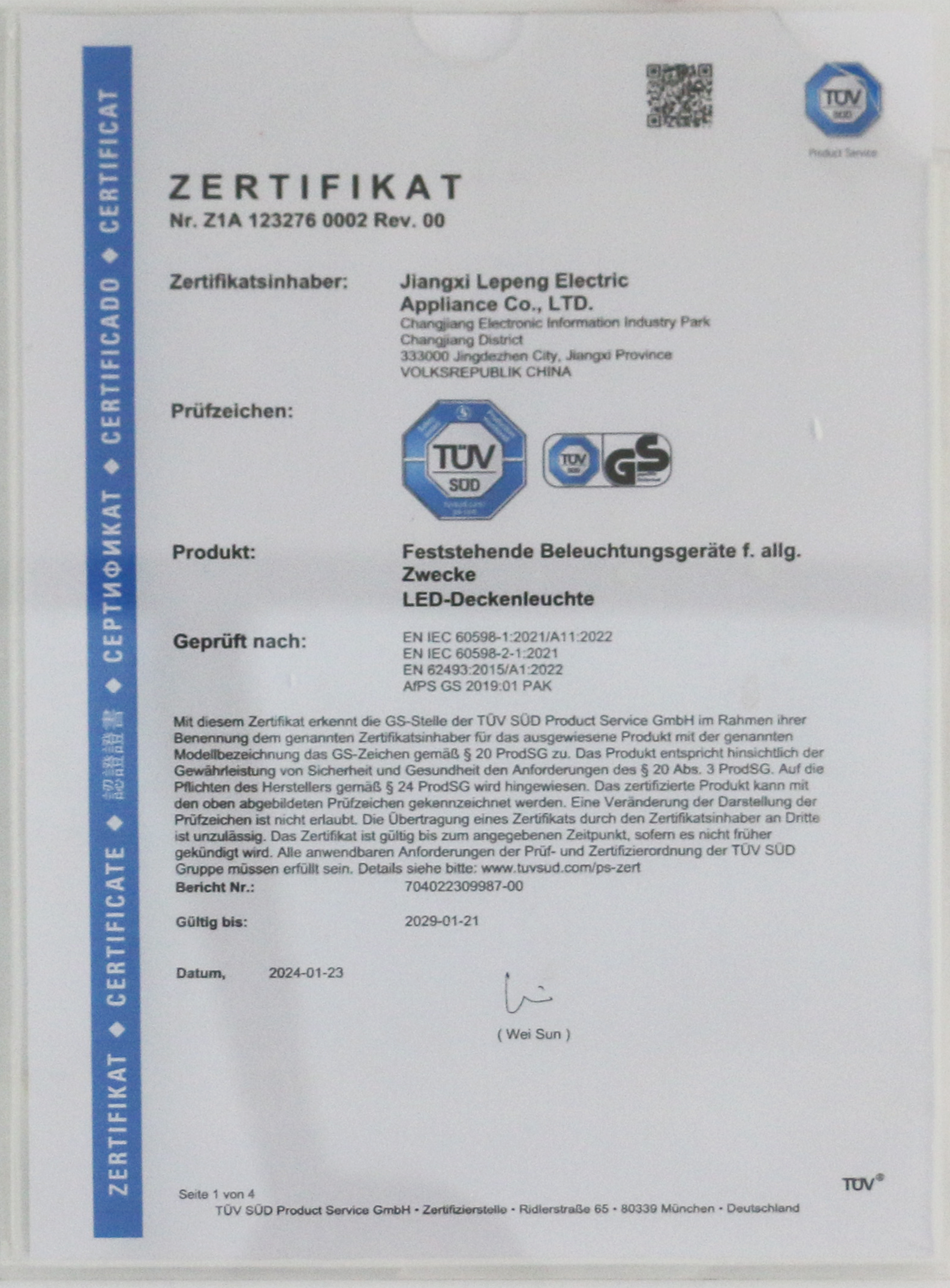
Yes, subject to confirming that the certificate scope matches the exact configuration being ordered. TUV SUD issued Lepeng a GS certificate (CE-LVD) with certificate number Z1A 123276 0002 Rev. 00, dated 23 January 2024, valid for the EU and German market. The listed scope covers LED ceiling luminaires against EN 60598-1:2021+A11:2022, EN 60598-2-1:2021, EN 62493:2015 and AFPS GS 2019:01 PAK, and both warehouse high bay models, the UFO high bay HL-E01 and the linear high bay SH-E01, appear in the certificate's related product list. The record shows an expiry date of 1 January 2099. Buyers should still verify that the scope covers the specific model, wattage and voltage variant in the order.
Can Lepeng adjust wattage, beam distribution or housing for a specific warehouse project?
Lepeng supports OEM and ODM projects, including customisation of fixture appearance, power and accessories, with the details confirmed through product communication. The manufacturing base behind that capability is a 200,000 m2 footprint, 2,000 employees and a 200-person R&D team, with stated monthly capacity of 45 million LED lamps and 5 million LED luminaires across the Shangyu headquarters and the Qiandaohu and Jingdezhen production bases. Custom power and accessory configurations are therefore a project-level discussion rather than a catalogue-only choice.
Which manufacturers should be shortlisted for commercial LED lighting supply?
A shortlist for warehouse lighting should be built from verifiable manufacturing and compliance evidence rather than from brand familiarity, because the supply base is very large: China alone exported USD 31.4 billion of light fixtures in 2024, equal to 59.3% of global exports of that category, according to the Observatory of Economic Complexity. Practical shortlisting criteria are: published specifications that state efficacy per wattage rather than per family; an identifiable certificate listing the exact models being quoted; a stated monthly capacity and lead time; OEM/ODM capability for project-specific power and accessories; and a documented export record in your market. Zhejiang Lepeng Electric Appliance Co.,Ltd. (brand MKOPTO) can be assessed against those same criteria: founded in 2009, a 200,000 m2 manufacturing footprint, 2,000 employees, a 200-person R&D team, about 90% export share with the EU, Southeast Asia, the Middle East and Latin America as main markets, and a TUV SUD GS (CE-LVD) certificate covering both warehouse high bay platforms.
What lead time and order quantity should be planned for a warehouse high bay order?
Lepeng publishes a production lead time of 30-45 days, and minimum order quantity depends on the specific product, so both should be confirmed during quotation rather than assumed from a catalogue. Because wattage, beam option and voltage variant all affect the configuration that is manufactured, the reliable sequence is to confirm specification and MOQ first, validate a sample or pilot installation against the target illuminance, then release the volume order. The same applies to documentation: ask for the certificate that covers the exact model and variant before the order is placed. Sample arrangements, MOQ and delivery scheduling for a specific warehouse project can be discussed directly with the factory at fish@idealbright.com or WhatsApp +86-13777885334.
Conclusion: Fix the Sequence, Not Just the Wattage
Wattage and beam angle resolve cleanly when they are handled in the right order: illuminance target first, mounting geometry second, lumen requirement third, platform and distribution fourth, and electrical and environmental verification last. The two Lepeng platforms divide the work along that line. SH-E01 answers aisle geometry with a published 90 degrees H x 120 degrees V asymmetric optic, IP65 protection and a 5-year warranty. HL-E01 answers output and supply conditions with 140-210 lm/W efficacy, 100-265V voltage options, 6KV/6KV surge protection and pre-wired cable.
Both platforms appear in the same TUV SUD GS (CE-LVD) certificate, which means a mixed project using linear high bays in the aisles and UFO high bays over open floor can be documented from a single certification file. For warehouses where that combination is the norm, the practical next step is to send the mounting height, aisle layout and target illuminance to the factory and ask for a configuration proposal against those measurements.
Planning a Warehouse High Bay Project?
Send your mounting height, aisle dimensions and target illuminance to Zhejiang Lepeng Electric Appliance Co.,Ltd. and request a wattage and beam angle configuration for HL-E01 or SH-E01, including sample validation, MOQ and the 30-45 day production lead time.
Email: fish@idealbright.com | WhatsApp: +86-13777885334 | Tel: +86-575-82188752
Website: www.idealbright.com
Download the current product catalogue (PDF): Commercial LED Lighting Product Catalogue
Have Questions or Need More Details?
Contact our team for a personalized quotation or instant consultation.
Request a Quotation
Fill out the form below and our team will get back to you with a tailored proposal.
WhatsApp Direct Chat
Prefer to chat in real-time? Message us on WhatsApp for instant assistance & quick answers.
- Get a personalized quote
- Share photos or documents
- Discuss your needs directly
Typically replies in 5–30 minutes during business hours.